The Art of Silent Film: Al Christie’s Contribution to Early Hollywood

Long before modern blockbusters filled theater screens with explosive sound and color, silent films captivated audiences through pure visual storytelling. This lost art form, which flourished from 1894-1929, experienced a revival when The Artist won major awards in 2011 for its faithful recreation of silent cinema’s magic. The American Heritage Center preserves important records from this foundational period in film history, including the Al Christie papers.

In the United States, the major center for film-making was in the New York-New Jersey area, until Nestor Film Company sent Al Christie to Hollywood to open a West Coast studio in 1911. Christie later started his own production company, Christie Film Company, which specialized in comedy.

Silent film acting was a different art form. Silent films contained no audible dialog, and the music was normally provided by an organist or pianist in the theater where the film was shown.  Silent film actors learned to convey emotions with facial expressions rather than with broad stage gestures. The film acting style was considered more naturalistic than theater acting.

The Nervous Wreck, Christie Film Company, 1926, Al Christie papers

When advances in technology allowed for sound, silent films fell rapidly out of favor. Yet two decades of work had produced many films that deserve not to be forgotten. The Christie studio had produced hundreds of comedy “shorts” (about 20 minutes) and some full length features. Among the latter was The Nervous Wreck (1926), a comedy about a hypochondriac who learns to take action and win the girl in the Arizona desert. The process involves holding up a car full of tourists with a monkey wrench.

The Al Christie papers at the American Heritage Center contain many scripts, synopses, and outlines for silent films. Not all of these films have survived. The production files from the Christie studio offer insight into what it took to make and market silent films. To see examples of these production materials, including publicity stills from The Nervous Wreck, visit our Virmuze exhibit “Collection Spotlight: The Al Christie Papers.”

Posted in Hollywood history, motion picture history, popular culture, resources | Tagged , , , , | 6 Comments

Online Finding Aid Available for the Karl C. “Sunny” Allan Papers

The Allan Papers document 20th century- outdoor recreation.

Karl C. “Sunny” Allan (1886-1978) was born in Ogden, Utah. He worked as a telephone lineman in the early 1900s, and was part of the Bureau of Reclamation crew that built a telephone line from Ashton, Idaho to Moran, Wyoming. In 1913, he joined the U.S. Forest Service and worked in the Targhee National Forest building telephone lines to fire lookouts. In 1918, he became a district ranger at Camas Meadows, Idaho. He worked at the Black Rock ranger station in Wyoming from 1930-1938, and the Jackson Lake ranger station in Wyoming from 1938-1942. From 1944-1956, Allan worked as a ranger in Grand Teton National Park (Wyo.) and managed the Rockefeller Wildlife Range. He and his wife, Esther, lived in the Jackson Hole area for more than 40 years.

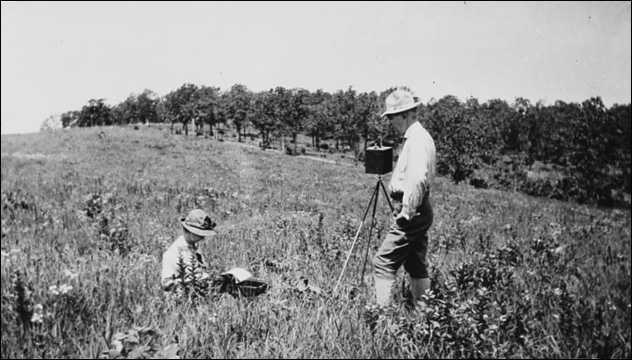
The Allan Papers also document wildlife management in the national parks. This image is from Yellowstone.

The Karl C. Allan Papers contains correspondence, much of it connected with the U.S. Forest Service, biographical information, government documents and other printed material mainly regarding the Jackson Hole and Yellowstone areas of Wyoming, manuscripts, notebooks, and maps. A large portion of the collection consists of photographs of the Allan family and many other Jackson Hole residents and visitors, work and life of park rangers, wildlife, and scenery in Grand Teton and Yellowstone National Parks, as well as Targhee National Forest, Wyoming.  You may view the collection inventory here.

Posted in environmental history, newly processed collections, outdoor recreation, resources, Wyoming history | Tagged , , , , , , | Leave a comment

Exploring the A.C. Ivy Papers: Insights into Cancer Research and Medical History

Andrew Conway Ivy (1893-1978) was born in Farmington, Missouri.  In 1913, at age 20, he received the Bachelor of Arts and Bachelor of Pedology degrees from Missouri State Normal School.  The research studies for his master’s degree (M.S., 1917) and doctorate (Ph.D., 1918) were in gastric physiology.  While completing the work toward his M.D. degree (Rush Medical School, 1922) he was instructor in physiology at the University of Chicago (1917-1919) and Associate Professor of Physiology at Loyola University of Medicine (1919-1923).

He returned to the University of Chicago as Associate Professor of Physiology, 1923-1925, and then was called to the chair of Physiology and Pharmacology at Northwestern University as the Nathan Smith Davis Professor where he remained until 1946.  From 1946 to 1953 he was Vice President of the University of Illinois in charge of the Chicago professional colleges.  In 1953, amid the much publicized controversy over his work on krebiozen, he resigned the Vice Presidency and continued as Distinguished Professor of Physiology and Head of the Department of Clinical Science at the University of Illinois.  From 1961-1966 he was Research Professor of Biochemistry at Roosevelt University and then worked at the Ivy Cancer Research Foundation.  From 1962-1976 his research was devoted exclusively to the body’s defense mechanisms against cancer.

Dr. Ivy also served as a consultant and advisor to the U.S. government and private organizations.  He was the Scientific Director at the Naval Medical Research Institute, 1942-1951.  He was a Special Consultant to the Secretary of War regarding war crimes of a medical nature at the Nuremberg trials, 1946-1947.  He also worked for the U.S. Army in the 1940s as a consultant in the Planning Division, the Research and Development Branch, and the Office of the Surgeon General, Nutrition Laboratory.

He was Executive Director of the National Advisory Cancer Council, 1947-1951 and held several committee positions for the National Research Council, 1940-1947.  While President of the American Gastroenterological Association in 1940 he engineered the founding of the AGA Journal and was its editor from 1942-1952.  He was active for the International Commission for the Prevention of Alcoholism and a co-founder and President of the National Conference of Educators to Eliminate Discrimination in Higher Education.

Dr. Ivy’s medical research covered almost every aspect of gastrointestinal physiology.  Some contributions came to be regarded as classics.  Examples include the introduction of subcutaneously transplanted organs to prove the existence of humoral mechanisms for gastric and pancreatic secretion, the discovery of the hormone cholecystokinin, the discovery of urgogastrone, and the elucidation of the effects of total gastrectomy in animals.  These and other discoveries clarified and simplified the understanding of how the stomach, pancreas, liver, and intestine secrete digestive enzymes.  Dr. Ivy wrote over 1500 scientific articles, mostly in the field of gastroenterology.  In addition to his articles he wrote two books, Peptic Ulcer in 1950 and Observations on Krebiozen in the Management of Cancer in 1956.

The A. C. Ivy papers, 1799-1984, contain extensive subject and legal files regarding the controversial drug krebiozen.  The public furor over the distribution of the drug is fully documented by correspondence, newspaper clippings, and legal documents.  The patient and physician records contain useful information about the use of krebiozen in treating patients with a prognosis of terminal cancer.  The papers regarding the Ivy Cancer Research Foundation document support for a test (by the Food and Drug Administration) of krebiozen.  There are also files that show A. C. Ivy’s long career in medical research concerning the gastrointestinal tract, his campaign to prevent abuse of alcohol, and his research for the Armed Services during World War II.

Posted in medical history, military history, resources | Tagged , , , , | 1 Comment

Hell on Wheels

Work progresses on the UPR at Green River, WY.

The AHC houses several collections related to the  construction of the transcontinental railroad, westward migration, and even “hell on wheels,” which is the term used to describe the transient collection of unsavory businesses (gambling houses, saloons, brothels) and people that followed the construction of the railroad west.

Jack Casement walking alongside work train

The John and Frances Casement Papers represent one of the AHC’s more notable collections on the topic. Jack Casement was a Civil War soldier who went to work on the Union Pacific’s transcontinental line from 1866-1869, which took him from Omaha to Promontory Point in Utah. The collection is composed mostly of correspondence between Casement and his wife during these years. Casement writes frankly of his difficulties in obtaining supplies and gives his opinion of business associates. Most of the collection, including all of the correspondence, has been digitized and made available online.

Laying the rails of the UPR.

Other AHC collections that feature material related to “hell on wheels” and/or the contstruction of the UPR include: the T. A. Larson Papers, the Samuel Chittenden Papers, the W. O. Owen Papers, and the Morton E. Post Family Papers.

To learn more, please visit some of our online resources about the transcontinental railroad and westward migration, including:

The Golden Spike Ceremony celebrating the joining of the Central Pacific and the Union Pacific railways at Promontory Summit, Utah, May 10, 1869.
Posted in Railroad History, Transportation history, Wyoming history | Tagged , , | Leave a comment

Old Faithful Speaks

Old Faithful Speaks is a 35 millimeter nitrate film created between 1933 and 1935 to promote Wyoming tourism. Yellowstone National Park was then (and is now) a world-renowned tourist attraction. The film features what may be the first audio recording of Old Faithful put on film.  It also appears to be exceedingly rare, with only two much-shortened versions known to exist at two other archives.

The American Heritage Center is committed to making audio-visual materials accessible to users of all kinds.  Click here to view other digitized items from the AHC’s collections.

Posted in Archival Film, outdoor recreation, Wyoming history | Tagged , , | Leave a comment

Your American Heritage Center FAQs Answered

October is Archives Month, and as part of its recognition of the auspicious occasion, the Smithsonian’s institutional archives has posted a blog titled The Smithsonian’s Top 6 Archives Myths.  So far as I know, here at the American Heritage Center we don’t have any archives myths (with the partial exception of the belief, by some, that founder Grace Raymond Hebard haunts our building), which, for Archives Month purposes, is too bad. However, we do have a set of “Most Frequently Asked Questions,” and perhaps those will do for the purpose.

1) How much “stuff” do you have? Roughly speaking, 90,000 cubic feet (a cubic foot is approximately the size of a carton of printer paper) of manuscripts and archives and 60,000 rare books. A cubic foot (actually 1.2 cubic feet, to be precise) storage box is 15 inches long; laid end to end our boxes would stretch 17.5 miles.  We’re also often asked how many “items” we hold. A storage box holds about 2,500 pieces of paper.  So 2,500 x 75,400 boxes = 188,500,000 pieces of paper.  Plus the 60,000 rare books, for a grand total of 188 million, five hundred and sixty thousand items (give or take a few).

AHC stacks; despite their appearance, we have plenty of room.

2) Are you full?  No, not even very close. We have approximately 100,000 cubic feet of storage space in our current shelving configuration. Were we to be able to raise the funds necessary to install compact (aka “mobile”) shelving into all our storage rooms we would increase our capacity by 25%. With compact shelving instead of having an aisle between every two rows of shelves there is essentially only one aisle for an entire room full of shelves—it’s just that this aisle moves to permit access to any given row of shelves. Not having so many aisles means more capacity for boxes and books. Unfortunately, it is difficult to interest philanthropists in supporting something as mundane (and essentially invisible) as additional shelving, so we can’t anticipate the additional space any time in the near future. Fortunately, based on our average acquisition rate, our current empty shelf space will last a couple of decades or so.

3) Do you take everything offered to you?   If we did, we would have filled up our shelves quite some time ago. Our archivists are skilled in making difficult decisions about both which collections we wish to acquire and which parts of a collection are perhaps not significant enough to warrant long-term preservation. In government archives the longstanding rule of thumb is that only about 5% of the records created are retained by the archives. For us, the percentage of material offered to us that we accept is much higher, but an important reason is that we are often offered material that we have ourselves requested be preserved here.

Our archivists spend time researching individuals and organizations whose contributions to our region or to one of the topical areas we collect is significant and substantial enough for us to solicit their papers. Even then, we typically don’t take everything offered to us; many records of modern life are simply not likely to be of great assistance to future historians, sociologists, and other researchers—a typical example would be utility bills or bank statements.

4) How do you decide what to take?  While the process of making such decisions remains a matter of professional debate, at the AHC we primarily approach such decisions using a combination of “macro appraisal” (a concept that originated in Canadian archives) and good old-fashioned American pragmatism. Macro appraisal posits that the first decision should be which creators of records (whether individuals or organizations) a repository considers relevant and significant enough to wish to document.

Only after identifying the records creators, according to macro appraisal, does an archives select among the records produced by a given individual or organization.  For that level of selection, AHC archivists are informed a good deal by the types of materials that have been, over time, most helpful to researchers. This is where our inclination to normally select diaries and emails but not acquire utility bills and all 150 phone-camera images of someone’s birthday party comes in. As you can readily see, archival decisions about what to keep are not based on an exact science.  However, we believe that we ought to be able to explain how and why we came to a given decision, rather than using something as inexplicable as intuition.

5) When will everything be digitized?  The short answer is “never.” The easiest explanation is that we have 188 million-plus items in our collections, and even at what, for the archival profession, has been our rapid pace of 75,000 scans in the past two years it would take 5,000 YEARS to digitize our existing holdings—and that doesn’t include all the material we would acquire in the meantime.  It also doesn’t account for the fact that copyright laws prohibit us from placing large portions of our holdings online.  Nevertheless, we will continue to work toward being at the front of the pack in terms of how quickly we do scan our collections.

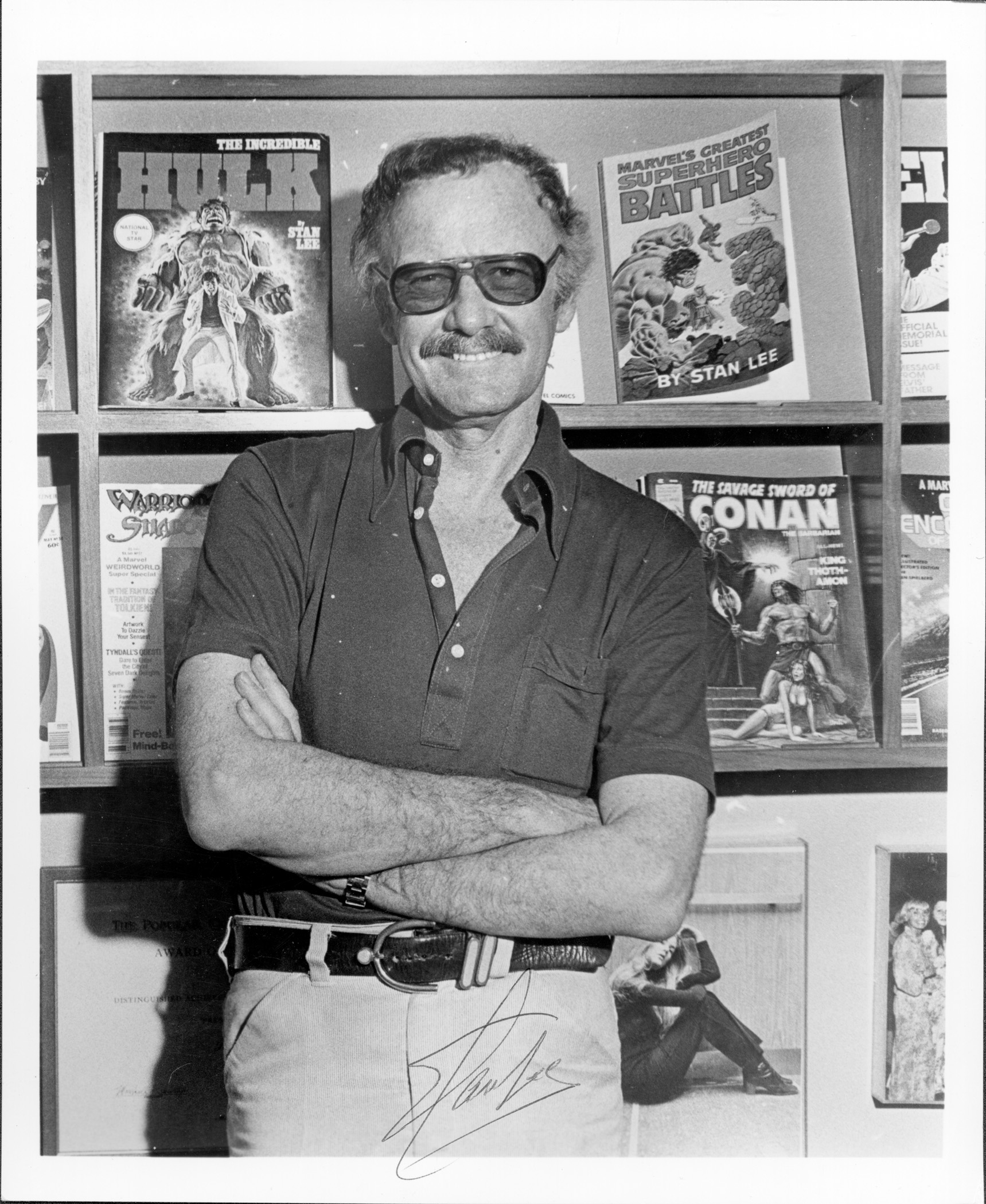
The papers of Stan Lee, above, are exemplary of our popular culture collections.

6) Why doesn’t the AHC collect only Wyoming history?  The Center does hold one of the most significant and substantial collections of Wyoming and Western history, particularly for the 20th century, in the nation. But we also hold internationally recognized manuscript collections for: U.S. aviation and aerospace, U.S. environmentalism, world economic geology, U.S. popular entertainment, U.S. journalism, U.S. military history, U.S. ranching, post-war U.S. conservatism, and “Asia through American eyes”; our rare book library documents (among many other things) the world’s religions, the global evolution of printing, and world-wide travel and exploration. Why do we have so much material that is not restricted to Wyoming or the Western U.S.?

The answer is that traditionally America’s land grant universities have believed their repositories—as well as the university itself—should give students and citizens the chance to learn broadly (thus virtually every land grant university has primary source collections that extend far beyond the state’s borders). The students and citizens of Wyoming, no less than those in any other state, deserve to have access to historical sources of relevance to some of the school’s broad areas of study. Moreover, events in Wyoming have to be understood in the context of national events, and events in Wyoming have repercussions in the rest of the nation.
Posted in Accessing historical documents, American Archives Month, Archival preservation, Archival work, Digital collections, Historical Preservation, popular culture, resources | Tagged , , , , , , , , | Leave a comment

Frederick “Fritz” Gutheim: Pioneering Planner and Urban Environmentalist

Frederick Gutheim

Frederick Gutheim

Frederick Gutheim was born on March 3, 1908, in Cambridge, Massachusetts. He was raised in Washington, D.C., where he attended Sidwell Friends School and later Dr. Devitt’s Preparatory School. He earned a degree from the Experimental College of the University of Wisconsin in 1931 and pursued graduate study at the University of Chicago. His early association with mentors like John Gaus and Lewis Mumford led him to the study of urban and regional planning. Gutheim pursued this interest as a bureaucrat, a writer and academic, a practitioner, and as an activist.

Gutheim became professionally acquainted with housing and planning policy while a staff member at the Brookings Institution. Between 1933 and 1947, he worked for federal agencies involved with housing and planning, serving the U.S. Army in the National Housing Agency during World War II. During this period, he also married Mary “Polly” Purdon, in 1935. He worked closely with Catherine Bauer at the U.S. Housing Authority as the assistant director of the Division of Research and Information. In 1933, he wrote portions of the TVA Act concerning planning.

Gutheim may be best known as a writer and a teacher. He was a staff writer on architecture and planning for the New York Herald Tribune between 1947 and 1949. He published The Potomac in 1949, a classic example of regionally-focussed environmental history. Over the course of his career, Gutheim wrote and edited for numerous magazines and journals including the Magazine of Art and the journal of the American Institute of Architects. He founded the Washington Center for Metropolitan Studies, now a research program of the Brookings Institution, as well as the historic preservation program at George Washington University. He advised and taught at the university from 1975, when he established the program, up to the time of his death.

Gutheim used his knowledge of bureaucracy and his academic prowess in a series of private consulting businesses, among them Galaxy, Inc., and Gutheim, Seelig, Erickson. Under the auspices of these firms, he advised organizations like the United Nations, the Canadian government, and the city of Newport, Rhode Island.

As an activist, Gutheim sought to protect the integrity of the landscape surrounding his home in Montgomery County, Maryland. In 1974, he established Sugarloaf Regional Trails, a non-profit organization dedicated to historic preservation and land conservation. He served as a trustee of the Accokeek Foundation and was instrumental in the opening of the National Colonial Farm, which was active in preserving native agricultural practices. He served on an array of historic preservation and planning boards from 1950 until his death in 1993. Gutheim was a catalyst for change and an exemplar of the mantra, “think globally, act locally.”

The Frederick Albert Gutheim Papers are comprised of materials related to both his professional and personal life. The collection is diverse, covering a wide range of topics and containing a variety of different types of documents. Topics included are urban and regional planning, architectural criticism, historic preservation, land conservation, and museum studies. The collection contains manuscripts of essays, speeches, and books written by Gutheim, application materials for numerous grants, photographs and slides, correspondence, notes, sketches of all kinds, films, records, audio tapes, and a wide variety of pamphlet material. The collection reflects changing attitudes toward planning and preservation from the early 1930s to the 1980s.

A question for readers: which files in the Gutheim Papers hold the most research interest for you?  Your comments to this post will help us to select files for digitization and delivery online.

Posted in city and regional planning history, conservation, environmental history, resources | Tagged , , , , , , , | Leave a comment

Delving into Animation History: The Legacy of Michael Maltese

Michael Maltese was born on February 6, 1908, in New York City to Italian immigrant parents, Paul and Concetta. He was married to Florence Sass in 1936 and had a daughter, Brenda, in 1938.  He started his career in the cartoon business at the Max Fleischer Cartoon Studio in New York City in 1935 where he worked as a cell painter, assistant animator, and overtime camera man.

To find employment in the lean years of the depression Maltese and his wife decided to move to Los Angeles. While waiting to hear about a job opportunity from Walt Disney, Maltese took a job with the Warner Brothers cartoon studio, where he stayed for the next twenty-one years. Maltese started as an in-betweener for Warner’s but was quickly moved to the story department. He worked for most of the directors, doing a number of cartoons with I. “Friz” Freleng and Fred “Tex” Avery, but his most memorable work was done with director Chuck Jones. From 1946 to 1958, Maltese worked exclusively with Jones, creating some of Warner Brothers’ most popular characters, including Pepe Le Pew, Road Runner and Coyote, and Yosemite Sam. He also wrote some of the most memorable Warner cartoons, such as The Rabbit of Seville, Duck Dodgers in the 24th ½ Century, One Froggy Evening, What’s Opera, Doc, and the Oscar-winning For Scentimental Reasons. He also wrote many of the songs that were used in his cartoons, including Michigan Rag from One Froggy Evening.

Maltese left Warner Brothers in 1958 to go to work for the fledgling Hanna-Barbera Cartoon Studio where he helped create such television series as The Flintstones, Huckleberry Hound and Quick-Draw McGraw as head of the story department. He retired in 1973 but continued to find work writing comic book stories for Gold Key Comics. He came out of retirement in 1979 to again work with Chuck Jones on a sequel to Duck Dodgers and a new Road-Runner cartoon.  Michael Maltese died in 1981 after a long illness.

The Michael Maltese papers are comprised of materials relating to his professional and personal life. The majority of the collection, however, is related to his work as a story man for cartoons. There are numerous title and credit cells from many of the Warner Brothers cartoons, photocopies of several storyboards from his work with Hanna-Barbera, and comic book scripts on which he worked. There are also several items from Maltese’s personal life, including 8mm movies, books relating to cartoons, correspondence, and several of Maltese’s sketches. There are also several transcribed interviews of Maltese and personal recollections written by him.  This collection is just one of many documenting the history of comic books and animation in the United States.

Posted in Animation, Animation history, cartoons, Entertainment history, motion picture history, popular culture, resources, television history | Tagged , , , , , | 3 Comments

Edward Ackerman: Sustainability Pioneer

Portrait of Edward Ackerman, Ackerman Papers

Edward Augustus Ackerman (1911-1973), was a geographer and water resources authority. He earned a Ph.D. from Harvard University in 1939 and was a professor at Harvard from 1940 to 1948. Ackerman served as a technical advisor on natural resources to U.S. occupational forces in Japan from 1946 to 1948 and then was a professor at the University of Chicago from 1948 to 1955. From 1952 to 1954, he served as assistant general manager of the Tennessee Valley Authority and became director of the water resources program of Resources for the Future from 1954 to 1958. Ackerman then became director of the Carnegie Institution from 1958 to 1973. He also served as a trustee of the Washington Center for Metropolitan Studies from 1964 to 1969. Ackerman served on several committees and panels pertaining to land use, population growth, long range planning, and environment and conservation issues.

The Edward Ackerman Papers contain material relating to his career in the sustainable management of natural resources, including his work on committees, task forces, and consulting. Much of this material consists of reports and correspondence regarding resource development planning throughout the United States, Japan, Brazil, and Puerto Rico. The collection also contains Ackerman’s publications, speeches, and professional conference papers; correspondence; material from conferences and professional organizations, particularly the Association of American Geographers; reports and supporting material; and miscellaneous office files containing photos, correspondence, and research.  The Ackerman Papers document the nascency of modern environmentalism.

Posted in city and regional planning history, environmental history, newly processed collections, resources, water resources | Tagged , , , , , | 3 Comments

Exploring Ecology’s Roots – The Clements Papers

Frederic and Edith Clements at their Alpine Laboratory near Pikes Peak, Colorado

Frederic Edward Clements, a leading botanist of the early twentieth century, was born 16 September 1874 in Lincoln, Nebraska, the son of Ephraim George and Mary Angeline (Scoggin) Clements.  He received a B.S. degree from the University of Nebraska in 1894, followed by an M.A. two years later and a Ph.D. in 1898.  Dr. Clements served on the faculty of the University of Nebraska’s Department of Botany from the time he was appointed laboratory assistant in 1894 until he advanced to full professor by 1907.

In 1899 Dr. Clements married Edith Schwartz, the daughter of New York businessman George Schwartz and Emma Young Schwartz.  Edith and Frederic met at the University of Nebraska, where Edith was a teaching fellow in German, and Frederic was a botany professor. Under his influence,  Edith herself began studying botany, receiving a Ph.D. in 1906 and becoming the first woman granted a doctor’s degree from the University of Nebraska.  The couple then began a lifelong partnership traveling the country and collecting ecological research together.

In 1907 Frederic Clements transferred to the University of Minnesota, where he spent ten years as professor and head of the department of botany.  He also served as state botanist and director of the Botanical Survey of Minnesota.

After leaving the University of Minnesota, Frederic Clements performed research work with the Carnegie Institution in Washington, D.C., which occupied the rest of his life.  In 1925 the Clements established a winter home and experimental gardens in Santa Barbara, California.  In the winter months the Clements supervised the work of the Coastal Laboratory at Santa Barbara.  During the summers they developed another ecological laboratory, Alpine Laboratory, at Pikes Peak, Colorado.  With funds from the Carnegie Institution, the Clements directed research aimed at determining the origin of species in the plant world by means of the impact of the physical factors in their environment.  The laboratories were often staffed by ecology students, and they attracted scientists interested in studying problems with agriculture, forestry, and soil conservation.

The Clementses collecting data in the field

The Clements’ many publications included “Adaptation and Origin in the Plant World: The Role of Environment in Evolution,” “Dynamics of Vegetation,” “Plant Succession,” and “Rocky Mountain Flowers.”  Edith served as illustrator for these publications, often translating them into several foreign languages as well.

The Clements retired in 1941 and continued their research with private funds.  Frederic also served as a consultant to the National Highway Research Board in 1935, and from 1934 until his death was a collaborator of the U.S. Soil Conservation Service.  In 1940 his alma mater, the University of Nebraska, conferred upon him the honorary degree of L.L.D.  He died 26 July 1945 in Santa Barbara, California.  Edith continued finishing their research manuscripts and writing articles in La Jolla, California, until her death (ca. 1969 or 1970).  The Clements had no children.

You can view an online finding aid for the collection and link to digitized material from the collection here.

Posted in conservation, environmental history, newly digitized collections, resources | Tagged , , , , | 1 Comment