A Red Carpet Collection

Photograph of Barbara Stanwyck, June 14, 1931. University of Wyoming American Heritage Center, Photo File: Stanwyck, Barbara.

Those of you who watch the Oscars  might have found yourselves wondering what it is like to hold the most coveted award in Hollywood. Well readers, question no longer!

The AHC is pleased to count, among the many informative and interesting items it holds, an Oscar award in the Barbara Stanwyck papers. The Oscar was presented to Stanwyck in 1982 “for superlative creativity and unique contribution to the art of screen acting.” The remainder of the collection contains scripts from projects Stanwyck was involved with, scrapbooks, printed materials, and other materials chronicling Stanwyck’s career.

The Stanwyck papers are an example of the exciting popular culture collections available for research at the AHC. You can also find the papers of William Dozier, the producer of the 1960s Batman television series, Jack Benny, a TV, film, and radio performer, and Stan Lee, the creator of Spiderman, Iron Man, and other Marvel comics superheroes, among others.

The AHC’s popular culture holdings are studied by scholars from around the world and are an important research resource for people ranging from academics to hobbyists.

When researchers come across the statuette, some of them imagine wearing their best, hold the Barbara Stanwyck Oscar in their hands, and imagine the camera flashes going off during their big moment.

Posted in awards, Film History, Hollywood history, popular culture | Tagged , , , , | Leave a comment

Black History Month Highlight: Elizabeth Byrd, Wyoming Politician

Elizabeth Byrd teaching in Cheyenne, WY. September 1967, American Heritage Center, Harriett E. Byrd Collection, Coll. #10443, Neg# 29475.

We continue our celebration of Black History Month by drawing much-deserved attention to Elizabeth Byrd.  She was another Wyoming “First,” in that she was the first African-American to serve in the Wyoming House of Representatives, as well as in the Wyoming Senate.

A Wyoming native, Byrd was born in Cheyenne in 1926.  She attended and was graduated from Cheyenne High School in 1944.  She enrolled in West Virginia State College, which is a “historically black college” and was at the time one of the most prestigious institutions in the U.S. for students of color.   Elizabeth Byrd graduated and sought work back home in Wyoming.  She found a position at the Fort F.E. Warren Air Force Base and taught elementary school there for decades.  In 1976, Byrd enrolled in a Master’s program for elementary education at the University of Wyoming.  Her professional life took a different course with her first bid for political office.

Elizabeth Byrd with Gov. Mike Sullivan signing Martin Luther King Jr. Day legislation, March, 1990. Elizabeth Harriett Byrd Papers, Accession Number 10443, Box 3, Folder 6

She ran for a seat in the House in 1980 on a Democratic ticket and served two consecutive terms before running for state Senate in 1988. She won that race as well.  Her years in elected office are most know for her successful efforts to persuade the state of Wyoming to recognize Martin Luther King, Jr. Day as a holiday.   In Wyoming, the third Monday of January is known as Martin Luther King, Jr. Day/Wyoming Equality Day.

The American Heritage Center holds the papers of Elizabeth Byrd among its collections.  If you’d like to look at the inventory for this collection, you can view it online.

Also, check out our “In Pursuit of Equality” virtual exhibit which addresses the influence of Wyoming women on effecting change and equality in the state.  Each of the three women–Nellie Tayloe Ross, Thyra Thomson, and Elizabeth Byrd–profiled in the exhibit employed political participation in elected office to further the cause of equality for Wyoming residents.

Posted in African American history, Black history, Black History Month, Political history, Politics, western politics and leadership, women's history, Wyoming history | Tagged , , , , , , , | Leave a comment

Come Fly Away: Trans World Airlines Records

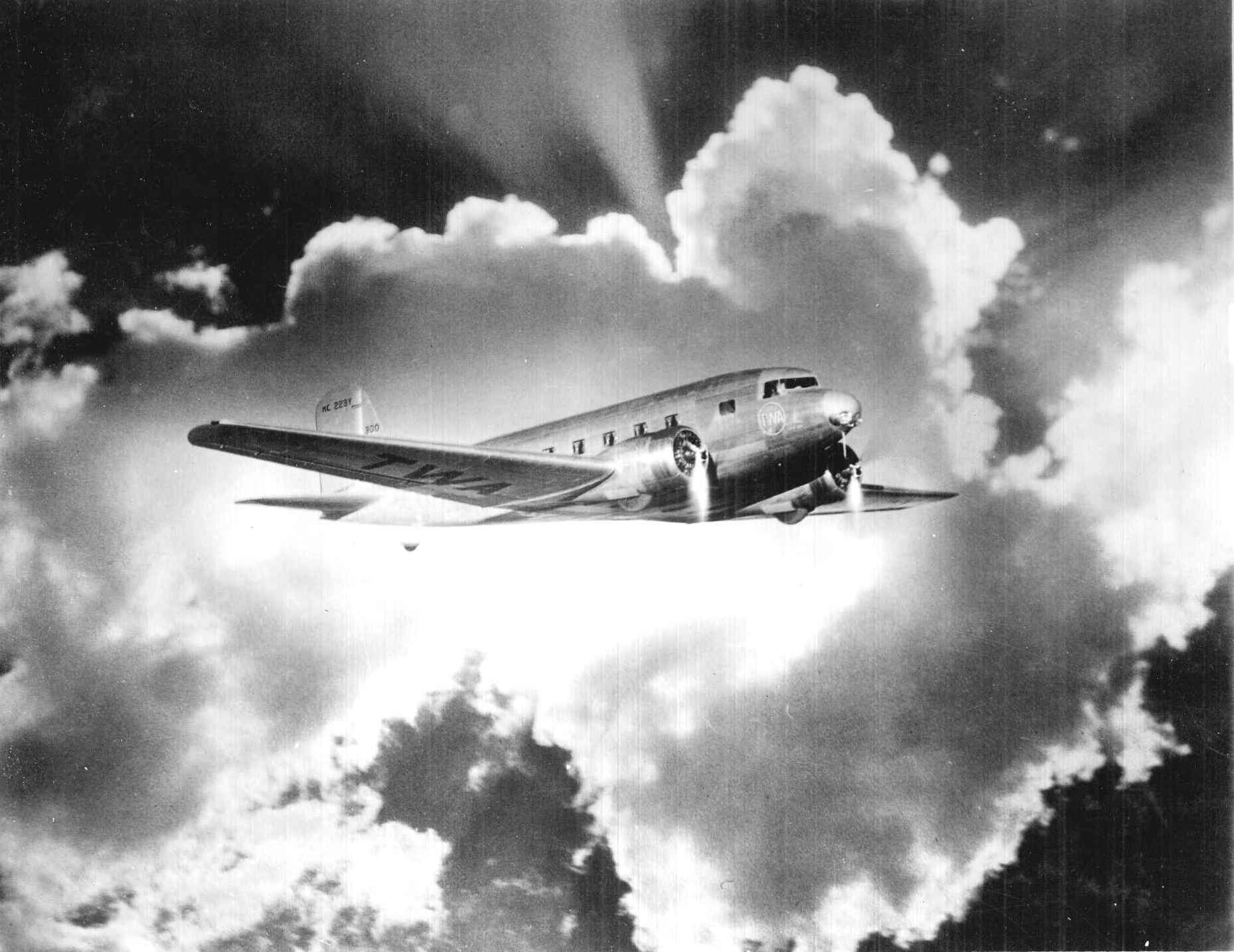
1929 TWA Luxury Liner, built by the Douglas Aircraft Company. Now that’s flying in style! TWA Records, Box 178.  American Heritage Center.

Trans World Airlines was a major airline in the 20th century. It existed from 1925-2001, after which it merged with American Airlines. It was originally named Transcontinental & Western Air (T&WA) because of the merger between Transcontinental Air Transport (T-A-T) and Western Air Express in 1930. It was the main U.S.-based competitor of Pan American Airlines and one of the first airlines to offer exclusively air-based coast-to-coast service, called the Lindbergh Line, from the advice the airline received from Charles Lindbergh. Because of the high profile advisers at T&WA, it was called “The Airline Run by Flyers.”

A TWA flight soars over the San Francisco Bay area, 1929. TWA Records, Box 178. American Heritage Center.

In 1938 Howard Hughes, business magnate, bought 25% of the airline and went on to control 78% of the airline by 1941. The airline prospered during WWII due to its business from Army flights. It was also during this period that Hughes’s leadership led the airline to become known for cutting-edge technology in the field of commercial aviation. In 1950 the airline officially changed its name to Trans World Airlines and became known as the “Airline to the Stars” because of its famous clientele. TWA was the first airline to hire an African American flight attendant and the first to show in-flight movies, starting in 1961.

More recently, TWA began to suffer from a series of misfortunes. On June 14, 1985, TWA Flight 847 was hijacked by Lebanese Shia extremists, later identified as members of Hezbollah and Islamic Jihad. In 1995 the airline declared bankruptcy and began to suffer troubles due to its aging fleet. On July 17, 1996, TWA Flight 800 exploded on a flight over the Atlantic Ocean near Long Island, killing all 230 people on board. While initial speculation was of a terrorist attack, the final National Transportation Safety Board report concluded that the cause was the ignition of fuel vapors probably caused by an electrical short circuit.  Finally, TWA merged with American Airlines in 2001 after declaring bankruptcy for the third time.

A TWA plane catching the light just so. TWA Records, Box 178. American Heritage Center.

The records within this collection mainly encompass the engineering, maintenance, and technical tasks of the company from 1944-1970. There are many reports from vendors such as Lockheed, British Aircraft Corporation, General Electric, and Boeing. Blueprints and technical drawings are also present. The collection provides a fascinating view of how an airline was maintained in the mid-20th century.

Posted in Aircraft accident, aviation history, newly processed collections | Tagged , , , , , , | 12 Comments

Black History Month Highlight: Bill Pickett

In honor of Black History Month, the AHC would like to share some of our collection material that highlights African-American life in the West and beyond.

The Cowboy

The original cowboy archetype in the US imagination was tall, rangy, and Caucasian—think of Owen Wister’s Virginian, Jack Schaefer’s Shane, or the first cowboy superhero, Hopalong Cassidy, played by the actor, William Boyd.  (Not coincidentally we have the papers of Wister, Schaefer, and Boyd here at the AHC.)  In reality, however, American cowboys were a more diverse mix and a significant percentage were African American.  One example, a famous figure on the rodeo circuit, is Bill Pickett, the first African American inducted into the Rodeo Hall of Fame.

Ben or Bill Pickett. On the back is written: “Ben Pickett, not Bill Pickett.” University of Wyoming, American Heritage Center, Photofile: Cowboys – Black Cowboys, Negative Number 6248.

“Bulldogging” Bill Pickett became famous for his innovative approach to steer wrestling.  As rodeo lore tells it, Puckett worked as a cowhand and observed bulldogs working the herds on various ranches.  These bulldogs managed their bovine charges by biting them on the lips.  The dogs would chomp down on the cow’s lip until the cow lay down and then the men could brand the animals.  Bill Pickett watched these dogs and decided to try it for himself; it apparently worked so well that he began to steer wrestle on the rodeo circuit.  This new technique came to be called “bulldogging” after the breed of dog that inspired it.

He died in 1932, the result of a ranch accident, but was inducted posthumously into the Rodeo Hall of Fame in 1971.

Posted in African American history, American West, Rodeo history, Uncategorized | Tagged , , , , , , | Leave a comment

Prohibition in Wyoming

January 16th, 2012 was the 92nd anniversary of the passage of the 18th Amendment to the U.S. Constitution, which transformed Prohibition into federal law.

Much of our understanding of Prohibition is framed by its urban impacts and consequences–bootlegging and organized crime, car chases though downtown areas, speak-easies on city blocks, police raids on drinking establishments, and bathtub gin manufactured in apartments.  But how did it affect rural areas?  The most frequently documented rural areas are in Appalachia, where the moonshiners ran their stills.  What about Wyoming?

Well, with the Otto Plaga Photograph Collection, you can witness how Prohibition would have affected Wyomingites.

Here are a few sample images from the collection, or click the link above to browse more images.

Bates Hole, Wyo. Red Creek. Seized by O.W. Plaga, Federal Agent and S.R. Owens, Federal Agent with Bill Irving. Otto Plaga photographs, Box 1, Fol 1.

Billy Hunter, Al Morton, Chris Jessen with still equipment in Green River, WY. Note the young “helper” on the left side of the photograph. Otto Plaga Photographs, Box 1, Fol. 1.

Stills seized by Plaga, Peyton, and Everhart near Douglas, WY Otto Plaga photographs, Box 1, Fol 1.

Stills after a raid in Wyoming. Otto Plaga Photographs, Accession Number 10397, Box 1, Folder 1.

For a general introduction to Prohibition history, Ken Burns’ documentary, Prohibition, originally released in October of 2011, is a good starting point. While Wyoming doesn’t feature prominently in Ken Burns’ work, viewers will have the opportunity to learn how Prohibition affected the U.S. as a whole, including some lesser-known unintended consequences

On December 5, 1933, the 21st Amendment to the Constitution overturned Prohibition.  Since then, whether your choice was an occasional beer or to forswear alcoholic beverages, it was once again a personal choice rather than a matter of Constitutional importance.

Cheers!

Posted in Photographic collections, Prohibition, Wyoming history | Tagged , , , | 2 Comments

Legal Eagles of Competition: Profiles in Anti-Trust Law

The Oxford English Dictionary defines anti-trust as “Opposed to trusts or similar monopolistic combinations.” Anti-trust law is also known as competition law and refers to law that promotes or maintains market competition by regulating anti-competitive conduct by companies (Wikipedia). At any rate, the 20th century saw a flurry of anti-trust legislation and other measures to prevent the growth of monopolies by corporations. These lawyers’ papers reflect such efforts.

Philo Clarke Calhoun, undated. Philo C. Calhoun Papers, Box 2.

Hugh Baker Cox (1905-1973) was one such lawyer. Cox worked in the anti-trust division of the U.S. Department of Justice during the 1930s and early 1940s. He also served on the Board of Economic Warfare in London, concentrating on economic intelligence activities. Perhaps most notably, Cox worked on federal policy formulation regarding a dispute between Montgomery Ward and the National War Labor Board which resulted in the seizure of the company under presidential executive order.

Paul H. LaRue was an anti-trust lawyer who worked with the Federal Trade Commission (FTC) in Washington, D.C. first as a trial lawyer and later as attorney-adviser to the FTC commissioner in the early 1950s. After, he moved to Chicago and joined the firm Chadwell, Keck, Kayser, & Ruggles in 1958. There, he was a public member of the Illinois Conflict of Interest Laws Commission. LaRue authored many works on anti-trust publications.  Earl W. Kintner (1912-1991) also worked as a trial lawyer with the FTC and went on to become chairman from 1959 to1961. Kintner was a proponent of industry self-regulation while simultaneously enforcing anti-trust measures. He also published and lectured on antitrust law, trade practices, and administrative law.

Young Philo Calhoun on a road trip with friends, undated. Other photographs in the collection show the group fishing and enjoying an outdoor meal with china teacups. Philo C. Calhoun Papers, Box 12.

Philo Clarke Calhoun (1889-1964) was an anti-trust lawyer who often partnered with another anti-trust notable, Judge Thurman Arnold. Together, the two are remembered as some of the New Deal’s most iconoclastic “trust-busters.” However, Calhoun had another, decidedly less aggressive hobby – Dickens scholarship. Calhoun was an expert on rare editions of Charles Dickens’s works, and also enjoyed hymnology.

Louis B. Smith in his office, undated. Louis B. Smith papers, Coll. No. 8272. Box 23, Folder 1.

Finally, Louis B. Schwartz was an attorney and lawyer known for his work on anti-trust laws and penal code reform. A legal scholar, Schwartz taught at a number of institutions, including Pennsylvania State University, the University of California’s Hastings College of Law, Harvard, Cambridge, and others. Schwartz served as a member of the Attorney General’s National Committee to Study the Anti-trust Laws from 1954-1955 and director of the National Commission on Reform of Federal Criminal Law from 1968-1971.

Posted in Anti-Trust Collections, Legal History, New Deal Era, Politics | Tagged , , , , , , , | Leave a comment

World War I on both sides of the Atlantic

Women giving refreshments to soldiers, July 1918. American Heritage Center, Muriel Valentine Papers, Box 1.

The hit miniseries “Downton Abbey” is educational as well as absorbing. With its World War I setting and its perspective from the British aristocracy, the fictional account of one family’s experience during the Great War might put you in the mood to bone up on a bit of World War I history.

While Downton Abbey might provide some perspective on World War I, The American Heritage Center, among its military history collections, has several collections that document Americans’ experience in the massive global conflict that forever changed world politics, national borders, and individual lives.

The Neil T. McMillan papers shed some light on a Neil McMillan, a soldier who served in the U.S. Army during World War I and became so enraptured by the new flying machines that he transferred to the Army Air Corps.  His military service nurtured his love of flying and he was involved in aeronautics for the rest of his working life.

Thurman Wesley Arnold Papers, Box 102A, Folder 12.

Thurman Wesley Arnold, a native of Laramie, attended the University of Wyoming, Princeton, and Harvard, and practiced law in Chicago for two years before enlisting in the U.S. Army during the Great War.  He served in France during the war and his collection contains photographs of life in the training camps and on the field.  Portions of his papers have been digitized, including the photographs of his World War I service.

For some perspective on what it would have been like to serve in the Austrian Air Force during World War I, the Wolfgang B. Klemperer papers can provide you with some photo documentation.  You’ll find scrapbooks that depict his service to Austria in boxes 2 and 3 of the collection.

Albany County men ready to leave for WWI training camp, 1918. American Heritage Center, Ludwig Svenson Collection, Negative Number 6226.2A.

Fictional accounts can do a lot to bring historical events alive, but the truths on which they’re based can give much more contextual–and perhaps little known– background to such significant and widely researched events.

Posted in American history, aviation, aviation history, military history, Uncategorized, World War I | Tagged , , , , | Leave a comment

Hydro-power and the Pacific Northwest: The Louis E. Rydell Papers

Louis Rydell at Cushman Dam #2 outside of Tacoma, WA, 1929. Louis Rydell papers, Box 14..

Louis Ernest Rydell (b. 1899) was a civil engineer whose work included the planning of river basins for development of hydro-electric power, flood control, navigation, and irrigation, both in government work and with private firms.

Much of his work has been the planning of large dams, including site selection, investigation, preliminary design, cost, and economic feasibility studies and reports.  Rydell worked for the U.S. Army Corps of Engineers from 1934-1959.  From 1935-1948 he directed the project planning phase for the Willamette Basin Project in Oregon.  From 1948-1959 he was Chief of Planning and Reports in the Walla Walla, Washington district, during which he worked on plans and studies for the Columbia and Snake River basins.  From 1955-1959 he was assigned by the U.S. State Department as a flood control advisor to Ireland on the Shannon River.

A river excursion for visiting engineers during the International Irrigation Study, a conference held in Tokyo, Japan. May 1963. Louis Rydell papers, Box 14.

From 1959-1965 he was a consultant with Harza Engineering Company and supervised planning studies on the Indus River Basin in Pakistan.  From 1966 until his death, he worked as a private consultant for the U.S. Army Corps of Engineers in the Ohio River Basin, TAMS in Brazil, and the Montreal Engineering Company in Iran and Guyana.

The Louis E. Rydell collection contains files related to various projects on which Rydell worked, including projects in Brazil, Guyana, Iran, and Pakistan.  Also present are U.S. Army Corps of Engineers reports on water resource development projects in the United States West, particularly in the Willamette and Columbia River basins.  Rydell’s papers also contain a large number of subject files relating to dams, hydraulics, and flood control.  Also Researchers using the collection will also find articles written by Rydell as well as photographs of Rydell in activities related to his professional career.

If you would like to look at the online inventory for the Rydell papers, you’ll find it here.

Posted in Civil Engineering, Dam Construction, Flood Control, U.S. Army Corps of Engineers, Uncategorized | Tagged , , , , , | 1 Comment

Reflections on the Evolution of Air Travel

Are you a nervous flier?  Perhaps it will make you feel better to see that back in the day, it could have been a lot worse to fly.  We’ve used our collections to illustrate just several of the reasons that it’s much, much safer to fly in this modern age.

  1. Covered jetways to the aircraft.  No risk of slipping and falling on an icy tarmac.

Passengers on the first transcontinental flight from Los Angeles to the East Coast, July 8, 1929. AHC Collections, Charles A. Lindbergh Photo File.

2.  Runways and tarmacs that are clearly defined, easy to navigate, and paved.  No need to worry about the plane’s tire’s slipping and skidding in mud.

Secure your seatbelt for takeoff and landing. Just look at that packed-dirt runway! Richard Leferink Scrapbook, Box 14.

3.  Protection from the elements, especially welcome at cruising altitudes of 30,000 feet.

Lieutenant Commander Ellsion and Glen H. Curtiss in plane, North Island, San Diago, California, 1910, University of Wyoming, American Heritage Center. Photo File: Planes–Old Timers .

4.  Small pets can still travel in the cabin, but must be restrained in a mesh carrying case.  This is safer for everyone since it reduces the risk of animals biting other passengers, but also lessens the chances that a pet might tumble out of the cockpit.

Early aviator Roscoe Turner with pet lion cub Gilmore.  Roscoe Turner Papers, Box 113, Folder 7.

Early aviator Roscoe Turner with pet lion cub Gilmore. Roscoe Turner Papers, Box 113, Folder 7.

However, now that air travel is such a routine part of our lives, there is one drawback.  There are no crowds of attractive young people to see us off and welcome us back once we’ve touched down on the ground again.

Photo of Roscoe Turner and women in bathing suits with the “Flying Cigar Store.” Roscoe Turner Papers, Box 82, Folder 18.

But I think that most of us would agree that arriving safely at our destination far outstrips any departure or arrival fanfare!  Safe travels, all!

Posted in aviation history, Digital collections | Tagged , , | Leave a comment

The Oregon Trail

View of the Oregon Trail near Split Rock in Natrona County, Wyoming. Grace Raymond Hebard papers, AHC.

You might remember this game; it was a classic facet in many an elementary school classroom.  Its release in Wii format in 2011 brought the joy of cholera and “fording the river” to a whole new generation.  While this was exciting indeed, there is much to be said for reading up on what it was really like to travel the Oregon Trail.

The American Heritage Center has got you covered!  We have diaries, maps, personal histories, and photographs that reveal what life on the trail was really like.  May we suggest the W.W. Morrison papers, a passenger agent of the Union Pacific Railroad who was also a historian of emigrant trails and pioneer graves.  His collection contains all sorts of goodies for someone interested in the authenticity of the trail, including photographs of several of the Donner party’s graves.  Or, perhaps the Oregon-California Trail Association records, which contain many diaries from travelers on the Oregon and California trails.  Or take a sampler approach, and see what we have available in digital form.  Try searching with terms like “Overland Trail” or “Oregon Trail” to get a feel for the nitty, gritty side of life on the trail.

Oregon Trail Route through Wyoming, Reproduction of information sheet, 1976, University of Wyoming, American Heritage Center, Paul and Helen Henderson Oregon Trail Collection, Accession Number 10188.

So, while you can now simulate the experience of the Oregon trail with the Wii, you can also take a step or two back in time and relive the journey with photographs and diaries of those who actually traveled the trail.  Happy travels!

W.H. Jackson drawing of Oregon Trail, University of Wyoming, American Heritage Center, Photo File: Trail – Oregon.
Posted in American history, Oregon trail, popular culture, resources, Westward migration | Tagged , , | Leave a comment