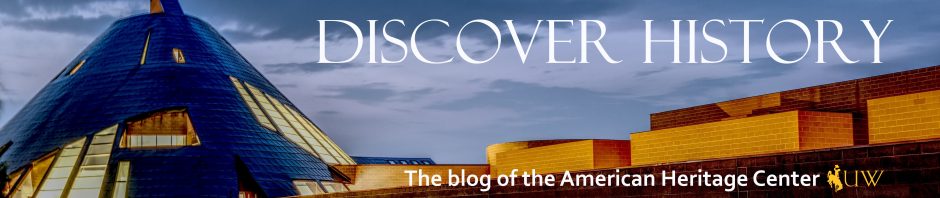
Antoine Predock, the visionary architect behind the University of Wyoming’s Centennial Complex, passed away on March 2, 2024, at the age of 87. The iconic structure, designed to house the American Heritage Center and the Art Museum, was composed of two distinct forms: an ovoid cone clad in black copper and lower, flat-roofed, cubic elements made of earth-toned concrete blocks. When the design was unveiled, it provoked controversy, but Predock’s scheme was eventually approved.
Predock conceived the design as an “archival mountain” situated within the larger geography of the plains, creating an “analogous landscape.” He positioned the building in relationship to distant mountain peaks and emphasized these features through carefully-placed windows. Predock’s award-winning design is evident in every line and curve of the Complex, a space that encourages exploration and contemplation, translating the natural world into concrete and glass.
Antoine Predock, left, discussing the schematics of the Centennial Complex using a scaled, dissected model, 1989. Image from the American Heritage Center Photo Files.
The building’s interior features a striking five-story, top-lit vertical space with a monumental timber structure and a rotunda space with a cosmological feature – a silver dollar embedded in the floor, illuminated by a shaft of sunlight on the Summer Solstice. Historians and critics have described the American Heritage Center as a “primitivist metaphor” and “oneiric,” seamlessly merging with the Wyoming landscape.
Early sketch of a Centennial Complex interior. This is “forest area” (now called the “Loggia”) in the American Heritage Center section of the building. Image from the American Heritage Center Photo Files.
Predock’s relationship with the University of Wyoming faced challenges, including a legal dispute over design aspects of the building. However, these moments, though difficult, do not diminish the brilliance of Predock’s contribution to our university’s landscape.
The Centennial Complex was featured in an issue of Architecture magazine in December 1993.
As we reflect on his legacy, we choose to focus on the countless ways in which Antoine Predock enriched our world with his bold and thoughtful designs. His work will continue to inspire students, visitors, and future architects for generations to come.
We extend our deepest condolences to his family, friends, and all those touched by his remarkable life and career. Antoine Predock’s architectural vision is a lasting element of the University of Wyoming’s identity, and his work at the Centennial Complex will continue to be valued and remembered.
Antoine Predock, 2005. Image accessed via Wikipedia.
Senator Gale McGee of Wyoming was an important figure in the groundswell of political change occurring in his time. Notably, as one of the rare Democrats in the state’s predominantly political sphere, he brought his extensive knowledge of history to bear on the policies he helped to shape.
Before becoming a senator, McGee taught American history at the University of Wyoming from 1946 until mid-1957. It was during this period that he decided to transition into politics, successfully campaigning and securing a seat in the United States Senate. His experience as a professor and his interest in history perhaps made him more idealistic than many who seek public office and he became known as an insightful and powerful orator.
After leaving UW for the Senate, he maintained contact with his university colleagues; in fact, fellow history professor T.A. “Al” Larson remained a close friend and was part of McGee’s “kitchen cabinet” throughout his political career. He ran for Senate on a platform of “new ideas” and as a senator he continued to express his willingness to embrace change and seek new solutions many times in his speeches and interviews. His extensive knowledge of history very much informed his political life and he also looked forward to the future with hope and expectation.
Gale McGee at the 1964 NY World’s Fair watching a transmission from his son Robert on the Picture Phone in the Bell System Exhibit. Image ah09800_003587, Gale McGee papers, Coll. No. 9800, American Heritage Center, University of Wyoming.McGee inspecting a replica of the communications satellite, Telstar 1, which was launched in 1962. Image ah09800_000381, Gale W. McGee Papers, Coll. No. 9800, American Heritage Center, University of Wyoming.
McGee’s perspectives are described in his own voice, in the following audio clips. The audio is sourced from digital recordings made from reel-to-reel tapes from his papers, now housed at the American Heritage Center. These materials were generously donated by his family. The full audio files are available for all to listen to in the AHC Digital Archives.
During a speech given to Marine Corps Command and Staff College (CSC) students in 1965, Senator McGee spoke about what motivated him to seek public office. He discussed the shift in perspective he experienced when he transitioned from his UW professorship to his Senate seat: “In the classroom, I had a lot more solutions to the problems of the world than I have in the Senate…The pressure of the responsibility for doing something about it causes you to take a second look at a lot of your crackpot ideas…If you really could impose that idea, would you still believe in it?” Further discussion of this as well as the freedom he felt as a freshman senator to explore new ideas is heard in this clip.
During a question and answer session after this speech, McGee expressed his belief in the dynamism of ideas. In this clip he stresses that “there’s nothing more powerful than ideas and books; they’re more powerful than bayonets,” as he explains his views on exercising wisdom and restraint in foreign policy.
There are many moments in McGee’s speeches and interviews that demonstrate his integrity, his commitment to his own convictions, and his determination to continue serving the public despite the frequent difficulties of public life. An illustration of this can be heard during his 1965 speech at the CSC. In the following audio clip, he is asked about the “vituperative quality of American political campaigns.” He replies in a humorous and also philosophical manner on how he viewed the negative and even threatening criticism directed at him in the course of his service in the Senate. McGee also expresses his concerns that vicious verbal attacks on political figures had the effect of “understandably frightening good people from even offering themselves as a candidate.”
The entire speech, including Q&A with the CSC students can be found in these clips.
Group portrait of five members of the “Class of 58,” a group of 15 newly elected democratic senators, whose election created the largest swing from one party to the other in the history of the US Senate. Gale McGee is pictured back left. In the front row, left to right are Senators Ed Muskie (ME), Gene McCarthy (MN), Phil Hart (MI), and Ted Moss (UT). Image ah09800_003611, Gale McGee papers, Coll. No. 9800, American Heritage Center, University of Wyoming.
A frequent theme appearing in McGee’s writings and speeches was corruption in government and he often spoke out against cronyism, misdirection, and the withholding of information from the public by elected and appointed officials.
In an interview on the radio program, C&O News Summary, broadcast on June 10, 1959, McGee gives his views on government concealment and corruption. He and host Tristram Coffin discuss the (then recent) confirmation hearings in the Senate regarding the appointment of Lewis Strauss to the post of Secretary of Commerce in President Eisenhower’s Cabinet. These senate confirmation hearings are depicted in scenes from the recent film Oppenheimer and the character of Senator McGee is prominent in them. As newly appointed head of the Interstate and Foreign Commerce Committee, the Wyoming senator played a central role in the proceedings and was a large part of the effort to block Strauss’ appointment.
In this clip from the interview, McGee accuses Strauss of behaving dishonestly during his Senate confirmation hearings and describes what he calls the “evasion of the point” in government generally. He believes it was exemplified in Strauss’s behavior during the hearings.
The five Atomic Energy Commissioners at Los Alamos in 1947: (left to right) Robert F. Bacher, David E. Lilienthal, Sumner Pike, William W. Waymack and Lewis L. Strauss. Source: Los Alamos National Laboratory via Wikipedia.
Here McGee notes difficulties the committee faced when trying to pin down Strauss’ position on the extent of the dangers of radioactive fallout from the development of atomic power.
Senator McGee goes on to further condemn Strauss’ vindictive conduct and attitude, which he felt could be a serious impediment to the “free interchange of ideas.” McGee also mentions instances of Strauss engaging in “cronyism” and explains that, at the outset of the hearings, he knew of no reason why Strauss’ appointment should not be confirmed. However, he developed doubts based on Strauss’ own behavior as the hearings progressed.
For those interested in delving deeper into this intriguing chapter of history, McGee’s research notes on the Strauss hearings are available in Boxes 986 and 999 of his papers. Boxes 1000 and 1001 hold transcripts of the hearings and McGee’s statements. These documents provide an invaluable resource for anyone seeking a comprehensive understanding of the events and the senator’s perspective.
From left to right Senators Joseph O’Mahoney (D-Wyo), Clinton Anderson (D-N.M.), Wayne Morse (D-Ore) and Gale McGee (D-Wyo) share a celebratory handshake at the Ohio Clock outside the US Senate Chamber after leading the effort to defeat the nomination of Lewis Strauss to be US Secretary of Commerce. Image ah09800_003608, Gale McGee papers, Coll. No. 9800, American Heritage Center, University of Wyoming.
McGee’s contributions as a senator and ambassador were notable. He was “a major player in the development of America’s post–World War II foreign policy and almost every legislative milestone in U.S. history from the 1950s to 1980,” as described by the University of Nebraska Press, publisher of an excellent biography of McGee, The Man in the Arena, by Rodger McDaniel.
In his dedication speech for the Abraham Lincoln Memorial Monument, McGee reveals some of the passion driving his own accomplishments as he points to the example of Lincoln’s extraordinary leadership. In his speech McGee expounds on one of his favorite themes: Allowing knowledge of the past to be a guide to new ideas and solutions rather than a cement that adheres us to modes of thought that no longer serve. The former professor elsewhere stated that his primary goal in the classroom was to teach students “how to think, not what to think.” Senator Gale McGee, in his life and throughout several careers, followed Lincoln’s advice, which he quotes in this audio clip, “…We must think anew and act anew.”
McGee in 1959, speaking at the dedication of the Abraham Lincoln Memorial Monument east of Laramie, Wyoming. Image ah09800_003610, Gale McGee papers, Coll. No. 9800, American Heritage Center, University of Wyoming.
The full speech can be listened to here:
The Gale McGee papers, housed at the American Heritage Center, are a valuable resource for researchers interested in the dynamic period of American history in which McGee played a significant role. As a US Senator from 1959 to 1977, McGee was involved in shaping key policies and legislation during the Cold War era, the Civil Rights Movement, and the Vietnam War.
The collection, generously donated by McGee’s family, includes his research notes, speech transcripts, correspondence, photographs, and audio recordings that provide a unique perspective on these pivotal events and the political landscape of the time. For scholars and students investigating 20th century American history, particularly the 1960s and 1970s, the McGee papers offer a wealth of primary source materials to explore and analyze.
Post contributed by AHC Digitization Technician Tana Libolt.
As the University of Wyoming’s official archive, the American Heritage Center is continuing our series on UW’s building history. We’re here to share the interesting tales behind some of UW’s treasured structures.
UW’s Geology Building is more than just a hub for learning about diverse minerals and geologic formations. It is an elegant piece of architecture, a historic landmark, and a showcase for natural science collections.
Science Hall. As gorgeous today as when it was constructed. Photo courtesy Leslie Waggener.
Construction of the building, then known as “Science Hall,” kicked off in the year 1900 – April 16th, to be precise. A cornerstone-laying ceremony, led by the Masonic Lodge of Wyoming, occurred on June 25th, marking the beginning of a tale that weaves together architecture, challenges, and the evolution of the Geological Museum.
On that June day, a procession marched from Laramie’s Masonic Hall on Second Street to the university. The “Kid band” led the way, followed by prominent Masonic leaders, city officials, and university dignitaries. They gathered around the building’s cornerstone to place a time capsule containing a masonic apron, local Masonic order proceedings, a UW catalog from 1899, Wyoming Experiment Station bulletins, photographs of UW, textbooks, and even a menu card from a society banquet. The cornerstone’s Latin inscription, “Per naturum ad Deum” (Through nature to God), added a touch of mystery and purpose.
Cornerstone of Science Hall, 2024. Photo courtesy Leslie Waggener.
The construction process had its share of drama as well. On Sept. 27, 1900, the Laramie Boomerang reported that a derrick fell on a worker’s foot, swelling it so badly it was difficult to tell if it was broken. A month later, on October 25, the Boomerang detailed another episode where a worker, under the influence of alcohol, engaged in a dispute with the contractor over wages. The disagreement escalated into a physical altercation, resulting in the worker attacking the contractor and inflicting a severe cut to his face.
Despite these difficulties, by December 1902, Science Hall, standing three stories high, became a reality, showcasing the craftsmanship of R.W. Bradley of Cheyenne. The Collegiate Gothic architecture, with its rectangular plans, pointed arches, and battlements added a timeless elegance.
Construction of Science Hall, 1900. Image ah400044_00155, Box 84, Samuel H. Knight papers, Coll. No. 400044, American Heritage Center, University of Wyoming.Science Hall, 1903. Image ah400044_00156, Box 84, Samuel H. Knight papers, Coll. No. 400044, American Heritage Center, University of Wyoming.
With other University of Wyoming buildings facing a space crisis, the prospect of moving into the splendid new structure appeared promising. However, a significant hurdle emerged – the absence of a heating system during the harsh Wyoming winter. Consequently, the only initial occupants were the sizable fossils formerly housed in the Main Building (now Old Main). The lack of heating even led to the postponement of a planned reception scheduled for Science Hall’s grand opening in early January 1903.1 Fortunately, warmth eventually embraced the structure, allowing faculty to settle in and classes to begin on January 19, 1903.2
Quantitative Chemical Laboratory, 1904. Two of the students are wearing uniforms of the cadet corps at UW. Image ah400055_000088, Box 11, B. C. Buffum papers, Coll. No. 400055, American Heritage Center, University of Wyoming.
Despite its promise, Science Hall remained a beacon of adversity. Positioned at a considerable distance from other campus buildings, the new building forced students, staff, and faculty to navigate through snow, ice, dirt, and mud sans the luxury of sidewalks or walkways. The journey to and from this fine edifice became a testament to perseverance amid the elements.
Campus view looking southeast after completion of Science Hall. Image ah100694, Samuel H. Knight papers, Coll. No. 400044, American Heritage Center, University of Wyoming.
Fast forward to 1920, when the growing needs of the Geology Department, together with the rising number of students, called for enlarging the structure. Science Hall was primed for that augmentation, a testament to the foresight of its designers.
In 1954, a final expansion phase saw Science Hall transform into the S.H. Knight Geology Building, solidifying its role as a hub for geological studies. This enhancement not only reshaped the building but also paved the way for a treasure trove of more than 8,000 specimens, including dinosaur skeletons, bird specimens, and minerals.
Section of the building added in 1954. UW file photo.
Before officially launching in 1956, the Geological Museum started as a modest collection under Professor J.D. Conley but flourished under the curatorship of Wilbur Knight and his assistant William Harlow Reed. Wilbur’s son Sam Knight, who later took the reins, added more exhibits. Dr. Samuel Knight’s metal dinosaur, standing at museum’s entrance since 1964, adds a unique touch to the building. The museum is open to the public, offering a fascinating glimpse into Wyoming’s natural history from Monday through Saturday, 10:00 am to 4:00 pm.
William Harlow Reed (1848-1915) in the “Bone Room.” After a varied career, including fossil hunting for rival camps in the “Bone Wars,” he was hired by Wilbur Knight in 1894 to help collect fossils for UW. In 1897 Reed became an assistant geologist and curator at UW’s geology museum. However, he continued to sell specimens, leading to friction with Wilbur Knight and his subsequent resignation. In 1903, following Wilbur Knight’s death, Reed was rehired by UW. His lack of a formal training led to several mixed-up specimen mounts at the museum. These were removed by Sam Knight, Wilbur Knight’s son, who replaced Reed after his death in 1915. Image ah001500, Photo File: Reed, William Harlow, American Heritage Center, University of Wyoming.Dr. Sam Knight (1892-1975) was a UW icon. He was first a student and later a professor. After earning a PhD in Geology at Columbia University in 1916, he came back to UW as an assistant professor. He is seen in his office at Science Hall that year. On his desk is a photograph of a young woman, most likely his new wife, Edwina Hall, whom he met at Columbia and married in 1916. Image ah400044_00060, Samuel H. Knight papers, Coll. No. 400044, Box 86, American Heritage Center, University of Wyoming.Dr. Aven Nelson (1859-1952), another icon, in Science Hall, 1914. By this time, the botanist had co-founded the Rocky Mountain Herbarium. Three years later, in 1917, he assumed the role of acting UW President, and in 1918, he officially became the President, maintaining this position until 1922. Image ah400044_00062, Samuel H. Knight papers, Coll. No. 400044, Box 86, American Heritage Center, University of Wyoming.
As we walk through Science Hall, it’s not just about the building – it’s a living time capsule filled with the University of Wyoming’s history and passion for science.
Want to See More Historic Campus Moments?
Science Hall’s colorful construction story—from cornerstone ceremonies to construction mishaps—captures just one piece of UW’s fascinating building history. If you enjoyed learning about how this 1902 landmark came to life, you’ll love our virtual exhibit “Keeping History Alive: 136 Years of Progress.” We’ve collected historic photos that show campus life from the early days right up to more recent times, giving you a real sense of how the university has grown and changed around these historic buildings. For additional perspectives on campus development and architecture, explore our exhibit “University of Wyoming: A Brief History of Campus.”
Children surround Spider-Man. Stan Lee Papers. American Heritage Center Collections, University of Wyoming.
A-listers, cutting-edge CGI, chaos, quips, and post-credit scenes—that is 21st-century Marvel Entertainment in a nutshell. Churning out one blockbuster production after another, Marvel has established itself as a live-action media mogul persistently setting the pace for family action movies over the past two decades.
My time as an educator prior to joining the curatorial team for the upcoming Stan Lee: Beyond the Book exhibit has made it evident that contemporary youths are ecstatic about what they are seeing on the screen. There was seldom a school day when I was not reminded of the reach of Black Panther, Spider-Man, Captain Marvel, and more. I watched as the heroes’ exuberant exploits leapt from the screen and latched themselves onto cherished t-shirts, bursting backpacks, and even to fruit-snack packaging! At elementary schools, secondary schools, and here on campus at the University of Wyoming, the influence and adoration of modern-day Marvel is tangible.
Evidence of Lee’s commitment to education is plentiful throughout his immense 127 cubic-foot collection at the American Heritage Center. And while noticing the connections between the artifacts housed at the AHC and the thrilling scenes coming from Hollywood studios has been absorbing, working with the Stan Lee Collection has resonated more with the educator in me than the consumer.
Associated Press article written by Mary Campell covering Mavel and Stan Lee’s relevance in educational domains. Circa 1972-1982. Stan Lee Papers, Box 6, Folder 10. American Heritage Center Collections, University of Wyoming.
By itself, the comic book form is an apt conduit for learning. Afterall, novels like Great Expectations are lovely, but students often meet a wall of text and are instantly intimidated, sleepy, or dramatically claiming death by boredom (trust me, I am an English teacher). Conversely, comics provide the perfect recipe to trick a developing and hesitant reader into a darn good time. The vibrant colors are alluring, the text is distributed throughout the page, the dialogue accelerates the plot, and the ability to turn page after page provides a significant boost to students’ self-efficacy. Furthermore, the congruity between illustrations, captions, and dialogue balloons offers students a digestible way to understand literary devices. Comics abound with symbolism, metaphor, allusion, flashback, foreshadow, and more. Illustrations make these techniques more interpretable, and the action displayed on the page encourages readers to make context-based inferences.
When comics mixed with Lee’s indelible vocabulary and his alliterative virtuosity, teachers and students alike realized that entertainment and education could be symbiotic after all. Lee was well aware of the potential of comics to inspire learning. In the article above, Lee is quoted, “The vocabulary in our comics is of college level…We figure the young readers will learn the word by its use in the context and if they should go to the dictionary to look it up, that isn’t the worst thing that could happen.”
Integrating academic, colloquial, and expressive language is a great way to improve reading comprehension and speaking skills, especially for remedial readers, students with special learning needs, and English language learners. The Stan Lee Papers feature scores of letters and comments from parents and students alike thanking Lee personally for his impact on their reading and writing skills and subsequently, the quality of their lives.
Personal letter to Stan Lee and Roy Thomas from a fan thanking them for their contributions to his literacy, love of learning, and teaching career. Stan Lee Papers, Box 102, ASF Correspondence 1992. American Heritage Center Collections, University of Wyoming.
Simply writing comics made a difference in the lives of people around the world. Yet, Stan Lee was compelled to do more than that. Educators of all levels wrote Lee requesting whatever volumes he and Marvel might be able to spare. He answered the call generously; for teachers, for researchers, for prisoners—for years.
Letter from Ms. Judith Rabinbach, a teacher at the Teen Learning Center in Amherst, Massachusetts, requesting comic books for high-risk students from Stan Lee. Stan Lee Papers, Box 16, Folder 3. American Heritage Center Collections, University of Wyoming.Letter from Fran Lyons, Secretary to Stan Lee, confirming Lee’s fulfillment of Ms. Rabinbach’s request. Stan Lee Papers, Box 16, Folder 3. American Heritage Center Collections, University of Wyoming.
What a great and inspiring thing to receive a bundle of comic books from one of the most reputable comic book writers in the history of the genre… but imagine the rush of a visit from the charismatic creator himself. Countless students across various grade levels were granted such a visit. Lee was renowned for lecturing at college campuses, including the University of Wyoming, but he also frequently visited elementary and secondary schools across the country. In collaboration with programs like Los Angeles County’s “Principal for a Day”, Lee would enter classrooms to discuss the importance of literacy and his favorite superpower—knowledge. He often convinced Spider-Man to take the day off from fighting crime to accompany him on these visits as well. Lee is pictured below at the then, University of Wyoming’s Lab School.
Stan Lee photographed at the University of Wyoming’s Lab School, April 1994. American Heritage Center Collections, University of Wyoming.
But we know that all superheroes need help. Stan Lee did too in his effort to promote the importance of education. In coordination with the American Spirit Foundation, Lee chaired the “Entertainers for Education” project, which recruited a diverse array of entertainers to fundraise for the development of educational programming and facilitated celebrity visits to schools to reinforce the importance of being a dedicated learner.
Page 1 of letter from Lee to film director Steven Spielberg encouraging him to join “Entertainers for Education.” September 30, 1991.
Page 2 of letter. Stan Lee Collection, Box 102, ASF Correspondence 1992. American Heritage Center Collections, University of Wyoming.
Lee’s efforts did not go unnoticed. The collection boasts several letters from Presidents Clinton, Bush, Reagan, and Carter expressing their appreciation to Lee for his dedication to supporting students of all ages. In the letter below, President Clinton commends Lee for his leadership during the 1997 America Reads Challenge.
Letter from President Bill Clinton to Stan Lee thanking Lee for his effort to support the America Reads Challenge. November 21, 1997. Stan Lee Papers, Box 1, Folder 14. American Heritage Center Collections, University of Wyoming.
Ultimately, Stan Lee will primarily be remembered for his contribution to the creation of famous superheroes like Spider-Man, The Fantastic 4, Black Panther, and more. However, the Stan Lee Collection offers insights that indicate that there was much more to the icon than initially meets the eye.
To discover more about Stan Lee, be sure to check out the exhibit—Stan Lee: Beyond the Book opening May 1, 2024, at the American Heritage Center. The exhibit runs through November 1, 2024.
‘Nuff said…no, actually, I will leave the last word to Stan:
Letter from Stan Lee to students around the United States advocating for “…the greatest power of all, knowledge!”. October 11, 1994. Stan Lee Papers, Box 102, ASF Correspondence 1994. American Heritage Center Collections, University of Wyoming.
He laid the objects thoughtfully on top of the three card tables in his garage, a showcase of coveted and kept personal history of his family’s deep connection with the town, and with coal. Frank Scigliano is a third generation Italian American and member of a multigenerational lineage who originally emigrated to the Kemmerer and Diamondville area to work in the local mines. His grandfather worked the mines, his father was killed in the mines, and he continued that labor tradition until he retired twenty some-odd years ago. He now spends his time attending high school sports games and regularly attends the local historical society’s meetings at the public library.
Frank Scigliano speaks with the post’s author Aubrey Edwards. Image courtesy Andrea Graham.
Frank ran his fingers along the black and white photographs and slightly bent miners’ tags, recounting personal vignettes of each object. Excitedly, he shared their provenance while weaving in longer narratives of ethnic social clubs, horrific mine disasters, the power of the United Mine Workers of America union, and the mining heritage of this place he calls home. He paused in his storytelling, a contemplative look on his face, and he quietly asked us, “What’s going to happen when the coal’s gone? Are people going to remember us?”
Retired UMWA mine workers meet at the Sinclair coffee every morning. On this morning they shared stories and personal photos with Aubrey Edwards. Image courtesy of Aubrey Edwards.
I visited Frank with a team of interviewers and oral historians from the University of Wyoming in the summer of 2022, recording the hopes and fears of residents in an uncertain time of energy transition. His concern with labor remembrance led me to this research. What Happens When the Coal’s Gone explores how evolving and shifting labor practices in this transitioning coal-centered economy affect public memory of labor and heritage. I am interested in how a community-rooted, object-centered preservation of labor can unfold within an accessible online space. In addition, I am interested in the ability of historical objects and material culture to convey labor history to a wider audience through personal and public memories.
Aubrey Edwards with Diamondville mayor Clint Bowen. Image courtesy of Aubrey Edwards.
Community bulletin board in the Sinclair gas station. Image courtesy of Aubrey Edwards.
Jere Borino’s father worked in Diamondville #2 mine, until an accident left him with sustained injuries, prohibiting him from returning to work underground. He opened up a smokehouse on the main street of Diamondville, an establishment where patrons could smoke cigars, drink whiskey, play cards, and visit the working girls in the back room brothel. The smokehouse has stayed in the Borino family for over 100 years, and in the early 2000s Jere turned it into the free, public history museum that it is today. “Things keep disappearing around here,” Jere told me, “This stuff in here connects us directly to our history.”
Jere Borino’s museum in his family’s smokehouse. Image courtesy of Aubrey Edwards.
A 2023 Teaching and Research Grant from the AHC, in addition to a digital preservation grant from the Wyoming Humanities, has funded three fieldwork trips to Kemmerer and Diamondville. It was through these trips that I was able to continue building relationships with memory keepers and collectors within the community.
The Naughton coal-fired power plant located near Kemmerer and Diamondville, January 2024. Image courtesy of Aubrey Edwards.
I worked with three public memory keepers who shared their collections of objects and artifacts with me: Jere Borino, Frank Scigliano, and Brad Carter. These collections exist in the form of home museums, accessible to anyone who is interested in learning more about regional history through these personal objects and memories. I photographed a selection of objects and the respective memory keepers contextualized the items, providing narrative entry points into larger stories of the labor and community creation of Kemmerer and Diamondville.
Kemmerer Hotel bar matchbook, from the collection of Frank Scigliano. Image courtesy of Aubrey Edwards.Chinese coins from site of Frontier No. 1 mine. In 1923, an explosion at this mine killed 99 men. Image courtesy Aubrey Edwards.
These objects, and the memory keepers’ contextualization, are the centerpiece of the website I am presently building out. In this interactive website there are also accompanying oral history excerpts, archival photos, video, and landscape imagery. The site will launch in March 2024 with a celebratory event in downtown Kemmerer.
Sample page from website in progress. Image courtesy of Aubrey Edwards.
At the AHC, they’re all about supporting UW’s commitment to teaching, research, public service, and cultural outreach. They make it possible by encouraging the exploration and interpretation of our nation’s history. Their Teaching and Research Grants are a great opportunity for UW students, faculty, academic professionals, and staff to undertake or build on interesting projects. Whether it’s independent research, collaborative efforts, crafting new courses, or organizing symposia, these grants can spark exciting journeys.
Welcome to the first installment in our series exploring the legacy of iconic buildings at the University of Wyoming. In this ongoing collection of posts, we’re taking a walk back through time to tell the stories behind some of UW’s most recognizable and storied structures. The American Heritage Center serves as the University’s official archive, preserving the history housed within the walls of UW’s historical structures.
As early as 1881, Governor John Hoyt urged the Wyoming Territorial Legislature to approve the allocation of 65 sections of federal lands to establish a university. Yet, action on this request didn’t materialize until 1886. According to historian Deborah Hardy, Hoyt said years later, “The territorial legislature might not have even entertained the idea of establishing a university if it had not promised certain financial advantages.”
Dr. John Wesley Hoyt (1831-1912) would go on to become the University of Wyoming’s first president, serving from 1887 to 1890. He was also Wyoming’s third territorial governor from April 10, 1878, to August 22, 1882. Image ah002515, Photo File: Hoyt, John W., American Heritage Center, University of Wyoming.
The Legislature in March 1886 created a University Building Commission that was authorized to “procure, by purchase, donation, or otherwise, in the name of the Territory of Wyoming, a suitable site within or near the limits of said City of Laramie, upon which to erect the said university building, and shall thereupon proceed to contract for, and superintend the erection of such building, in the manner herein provided.”
The site for the new campus was ten acres of land that had served as Laramie’s City Park, deeded to the town by the Union Pacific Railroad when “Laramie City” was first laid out. The University’s first building would be erected in the center of the former park.
Layout of Laramie in 1875 looking east from the Laramie River. The point located farthest east is labeled “Park.” That is the location of the future University Building, which would later become Old Main. Image ah00335_0117, Box 1, Folder 24, Fee and Murphy Family papers, Coll. No. 335, American Heritage Center, University of Wyoming.
A bid for the project was accepted on July 1, 1886. Denver architect Frederick Hale designed the building and Cook and Callahan of Laramie was contracted to build it at a cost not to exceed $50,000 (about $1,700,000 in today’s dollars). Initially, the building was to face south, but it was determined that a west-facing structure was ideal for the ground slope.
Designed when builders were inspired by a wide range of historical architectural styles, the building showcases a unique blend of architectural elements from the Chateauesque and Romanesque traditions. Chateauesque style borrows from the grand French Renaissance châteaux, often featuring steep roofs, turrets, and ornate detailing reminiscent of French castles. Meanwhile, Romanesque architecture is characterized by its robust and solid appearance, employing rounded arches, sturdy columns, and a sense of monumental simplicity. The building’s style is unique within the state and makes it one of Wyoming’s most distinctive public structures, second only to the state capitol in public recognition.
The University Building was swiftly constructed, with the Masonic Order laying its cornerstone on September 27, 1886. This cornerstone bears the inscription Domi habuit unde disceret, which may be translated “He had a home where he could learn.” Completion of the new structure was achieved by September 1, 1887. The facing, crafted from rough-cut sandstone quarried near Laramie and smooth Potsdam Sandstone near Rawlins, contributed to the enduring impact of the edifice on UW’s architectural landscape. Its design, characterized by its three portal layout, also left a profound influence on subsequent campus structures, such as Half Acre Gymnasium. Interestingly, Old Main is the only building on campus constructed during Wyoming’s territorial period, and one of only a handful of territorial institutional buildings left standing.
Caption written on paper attached to the photo: “Old Main. Original collodion print panel card taken by S.M. Hartwell & Son Studio of Laramie, Wyoming. Looking North-east toward Old Main, in early phases of construction, tower not complete yet… Probably dates ca. December 1886.” Image ah002750, Photo File: Colleges and Universities – University of Wyoming – Buildings – Old Main, American Heritage Center, University of Wyoming.Detail of photo above showing members of the construction crew.
Doors of the University Building opened to students on September 6, 1887, as they began arriving for classes that would begin September 12. The entire university was contained within the building’s walls, including a library, classrooms, laboratory, engineering shop, a gymnasium, and a music room. Upon Grace Raymond Hebard’s arrival in 1891 to take a position at UW, the stark surroundings framing the building caught her attention. Wilson Clough, a chronicler of the university’s history, noted her recollection of “no trees, no fences, no grass, no bushes. North of the building there was a buffalo wallow, and to the east nothing but sagebrush and the city cemetery on the distant slope.” Yet, she also found inspiration, “And in the midst the tower rose like a beacon light.”
A two-story, 500-seat auditorium on the second level quickly became an entertainment center for the still emerging town of Laramie. This “assembly room” held not only morning gatherings for the entire university, but also served as a primary lecture hall for visiting dignitaries.
Auditorium set up for commencement for the Music Dept., 1896. Photo File: Colleges and Universities – University of Wyoming – Buildings – Old Main – Auditorium, American Heritage Center, University of Wyoming.Auditorium in Old Main, ca. 1900. Photo File: Colleges and Universities – University of Wyoming – Buildings – Old Main – Auditorium, American Heritage Center, University of Wyoming.
Even though the room was large enough to accommodate the entire student body and faculty well into the early 1900s, it was not large enough to hold the huge crowd that came to hear President Theodore Roosevelt on his visit to Laramie in 1903.
President Theodore Roosevelt (hat over heart) speaking to a crowd from the steps of the “Main Building” in 1903. Included in the crowd were public school children, University staff, students, and faculty, and Laramie residents. Photo File: Roosevelt, Teddy, American Heritage Center, University of Wyoming.
The University Building remained the only instructional space on campus until the Mechanical Arts Building was completed six years later in 1893. As other buildings were added, it was commonly referred to as the “Main Building.” In 1922, the UW Trustees approved the official name of “University Hall.” However, by the mid-1920’s students were referring to it as “Old Main” – a reference to it being the old, main building on campus. The use of “University Hall” quickly faded.
Old Main was a popular spot for photos of staff, students, and faculty. Here is the University’s Camera Club in 1903. Image ah100841, Photo File: Colleges and Universities – UW – Clubs and Organizations, American Heritage Center, University of Wyoming.
When first built, Old Main had an impressive tower that was a landmark for the UW campus and the town of Laramie. But less than a decade after construction, it began crack and then to lean. Temporary measures were taken to secure it, but in April 1915, UW Trustees approved its immediate removal for safety reasons, and the project was completed in late May. Much unhappiness resulted from the loss of the tower. The Wyoming Student, the campus newspaper, expressed sorrow over the tower’s removal in an article dated December 22, 1915, lamenting, “But that the building should change, that it should lose any of its pristine dignity, is a loss to be regretted. And this is what has occurred. It has no longer all the dignity which used to grace it. With the destruction of the tower and the placing of an ugly, dun-colored, frail wooden structure where it formerly raised its head so high, the pride of the coming student and the pleasant memory of the departing graduate, much of the glory of the building vanished.” Efforts to add a new tower began almost immediately and continued unsuccessfully for decades.
Color postcard ca. 1910 with Old Main sporting its lovely tower. Image ah001872, Photo File: Colleges and Universities – University of Wyoming – Buildings – Old Main, American Heritage Center, University of Wyoming.Something’s missing. Oh yes, it’s the tower. Image ah300362, Ludwig & Svenson Studio Photographs, Coll. No. 167, American Heritage Center, University of Wyoming.
Old Main is part of the narrative behind the election of the first woman governor in the United States—Nellie Tayloe Ross. Her husband, William Ross, had been elected Wyoming’s governor in 1922. In September 1924, he was stumping the state to promote a constitutional amendment to adopt a severance tax on minerals. While on this strenuous speaking tour, he stopped in Laramie to speak to a large crowd in the Old Main assembly room. He became ill toward the end of his speech and was driven back to Cheyenne, where he was admitted to the hospital with severe abdominal pains. The next morning, his appendix burst and within days, he died. Although in mourning, his widow was nominated as the Democratic candidate for governor and won in a close election later that year.
Nellie Tayloe Ross and William B. Ross, August 10, 1923. Box 18, Folder 1, Nellie Tayloe Ross papers, Coll. No. 948, American Heritage Center, University of Wyoming.
In 1949, Old Main was completely gutted with structural enhancements added to make the 63 year old building more stable. Originally, the entrances of the building had been positioned above ground level, requiring visitors to ascend to the first floor before entering. However, in the renovation modifications were made, shifting the entrance to the basement level, allowing visitors to enter the building at ground level. The auditorium was replaced by a large central staircase and two stories of office space. The president’s office and those of other top UW administrators were relocated here, where they remain today.
Image of Old Main showing its three building entrances as first designed. Photo File: Colleges and Universities – University of Wyoming – Buildings – Old Main, American Heritage Center, University of Wyoming.
“Old Main” became the structure’s official title when the name was engraved in 1949 on the stone above the main entrance.
“Old Main” carved into the stone at the building’s entrance as shown in a photo from the 1954 University of Wyoming yearbook.Photo of Old Main by Theoren Sheppard, 2022. Theoren is the AHC’s photographer and Photography Lab Supervisor.
We’ll continue this journey through UW’s architectural past next time with a look at Science Hall (now the Geology Building) and the narrative surrounding its construction from 1900 to 1902.
If you’re interested in learning more about the University Archives program at the AHC, see our website at https://www.uwyo.edu/ahc/uw-archives/index.html. You can also contact University Archivist and Historian John Waggener at waggener@uwyo.edu or 307-766-2563.
How did a young man from New Jersey become one of the first Black bull riders on the professional rodeo circuit? The story of rodeo pioneer Abe Morris is one of determination in the face of obstacles.
Born in 1956, Morris discovered rodeo at a young age, spending summers with cousins who lived near a rodeo arena. He started riding calves at 8 and bulls by 10.
Abe Morris in action, ca. 1990. Abe Morris papers, Coll No. 11256, American Heritage Center University of Wyoming.
Bitten by the rodeo bug, Morris set his sights on honing his bull riding skills out West. He earned a rodeo scholarship to the University of Wyoming, where the rodeo team welcomed him with open arms. “The rodeo team just wrapped their arms around me,” Morris recalled in a 2023 interview. Their support helped embolden him to believe he could succeed in this predominantly white sport.
Abe Morris with his son Justin at Cheyenne Frontier Days, ca. 2015. Abe Morris papers, Coll. No. 11256, American Heritage Center University of Wyoming.
Morris joined the Professional Rodeo Cowboys Association circuit in 1977, racking up rodeo titles and honors over the next decades. He won championships at events like the Laramie River Rendezvous Rodeo and the “Open to the World” competition. Morris also became the first Black rodeo announcer in 1982. However, his bull riding career was cut short by a devastating hip injury in 1994.
Morris continued making rodeo history as an announcer and commentator. Throughout his years at Cheyenne Frontier Days, he shared his expertise, adding a touch of fun and insight for riders who were pushing the limits.
At a 2006 book signing in Woodstown, New Jersey, Abe Morris autographs books for 3rd and 4th graders, showcasing his journey from a New Jersey boy at the Cowtown Rodeo to a Black rodeo cowboy with triumphs and setbacks across the country, as detailed in his 2005 autobiography, My Cowboy Hat Still Fits. Photo from an issue of the South Jersey Times found in the Abe Morris papers at the American Heritage Center.
Today Morris’s barrier-breaking journey is documented in 16 archival boxes at the American Heritage Center. As we celebrate Black accomplishments this month and beyond, Morris inspires all who refuse to let obstacles stand in the way of their dreams.
Post contributed by AHC Archivist Leslie Waggener.
In the days before streaming became commonplace, it was an annual tradition in many households to look forward to the night when The Wizard of Oz film would air on television. Although not my favorite movie, it was always breathtaking to see the screen transition from black and white Kansas to the colorful world of Oz. In recent years, movie theatres have celebrated the seminal anniversaries of the film and have shown it on the big screen, amplifying the beauty of the cinematography.
The year 2024 marks the 85th anniversary of the film’s release. While we have previously described various AHC holdings relating to the Wizard of Oz, including the books and the film’s scripts, a recent acquisition to the Toppan Rare Books Library includes not only additional Oz books, but also a junior edition of the series, published by Rand McNally in 1939.
The eight books that are a part of Toppan’s Connie Marcus Collection. All of the books were published in 1939 by Rand McNally. Shown are (from left to right): Rinkitink in Oz; The Patchwork Girl of Oz; The Land of Oz; Jack Pumpkinhead and the Sawhorse of Oz; The Lost Princess of Oz; The Scarecrow and Tin Wood-man of Oz; The Road to Oz; and The Emerald City of Oz.
There is not a lot of information about this series available, but it does appear that there were nine books available. Toppan’s Connie Marcus Collection has eight of the nine books including Jack Pumpkinhead and the Sawhorse of Oz; The Scarecrow and Tin Wood-man of Oz; The Land of Oz; The Road to Oz; The Emerald City of Oz; The Patchwork Girl of Oz; Rinkitink in Oz; and The Lost Princess of Oz.[1]Each book has a main title for the central story, but also includes another short story from the Oz collections.
The numerous books and editions of L. Frank Baum’s The Wizard of Oz world are well-documented with checklists and published bibliographies dating back to the 1960s. However, these bibliographies—the most referenced being the Bibliographia Oziana—focus primarily on books published before 1919. Although the bibliographies include information on later editions, the 1976 issue does not mention a junior edition at all. Additionally, online and library catalog resources provide only basic publication information about the books.
The lead illustration for The Patchwork Girl of Oz, 1939.
While Baum’s books have been heavily studied, the junior edition seems to be a series that invites examination and further research, especially in areas of children’s literature. It could be that the edition’s publication date was intended to coincide with the film’s release. Were the books designed with thoughts of the motion picture cinematography in mind, considering how the land of Oz and its inhabitants are portrayed with the liveliness and richness of the movie as Dorothy opens the door to Oz? Like the movie, the colors in the junior edition are as bright and colorful as they were when first published. Although it is evident that the copies in Toppan have been read and used throughout the decades, there is no deterioration in the covers or the illustrations.
Beautifully tinted illustration from Rinkitink in Oz, 1939.
While the illustrations in the classic editions of the Oz books are known for their imagination and beauty, the illustrations and colors of the junior edition add to the stories. They bring to life some of the vibrancy and brightness described in the series’ text, adding a layer of vividness and charm to the narratives.
The junior edition featured artwork by long-time Oz illustrator John R. Neill, and the similarities to his other drawings are obvious. It would be interesting to see if his other editions are consistent or if he tailored these books for a different audience.
This is the lead illustration for the story “Tik-Tok and the Gnome King of Oz” included in Jack Pumpkinhead and the Sawhorse of Oz, 1939.
Perhaps one of the most popular questions asked of the Toppan staff is, “What is your favorite book in the collection?” We all have our different favorites and I find that my response differs depending on books I am using in a particular project. But I regularly point to this group of eight books more than any others because of the covers. Not only are they unique yet similar in their design, but the colors of the covers and illustrations draw the reader in. They’re inviting and add so much to the stories themselves.
The recent acquisition of the Oz junior edition opens up new research opportunities to explore an overlooked part of the beloved series’ publishing history. As we celebrate the 85th anniversary of the iconic film, these books’ unexpected condition, artwork and place in Oz literary chronology warrant closer study. They highlight the enduring imaginative legacies of author L. Frank Baum and illustrator John R. Neill.
Two of the books, The Emerald City of Oz and The Road to Oz which show two of the women characters and illustrates the varying ways in which John R. Neill depicted female characters of differing ages. These books are part of the Connie Marcus Collection.
Post contributed by Toppan Rare Book Library Curator Mary Beth Brown.
[1] The one Oz book that is not in the Toppan Rare Book Library collections is Little Dorothy and Toto of Oz.
Erin Stoesz, Wyoming State Science Fair Director and Assistant Lecturer in the UW Geology Department, recently completed an exciting project revising GEOL2080, which is UW’s general field geology course, with the support of a Teaching and Research Grant from the AHC. The goal was to incorporate archival materials from renowned UW geologist Dr. Samuel H. “Doc” Knight (1892-1975) into the curriculum so students could learn field geology skills using Doc’s own research as examples over the course of the semester.
Sam Knight’s passion for geology began in childhood. In this 1909 photo, Sam (left) assists in an excavation of dinosaur fossils in the Freezeout Hills near Medicine Bow. His father, Wilbur Knight, moved to family to Laramie in 1893 he became UW’s geology professor, but died unexpectedly in 1903. Sam went on to earn a 1913 bachelor’s degree at UW. After obtaining his PhD at Columbia University, Sam returned to UW in 1916 as assistant geology professor and museum curator. After serving in WWI, he returned to UW and became head of the geology department, a post which he held until he retired in 1963. Image ah400044_00018, Box 86, Samuel H. Knight Collection, Coll. No. 400044 , American Heritage Center, University of Wyoming.
Sam Knight enjoying a day of skiing at Happy Jack located near Laramie. Image ah400044_02800, Box 105, Samuel H. Knight Collection, Coll. No. 400044 , American Heritage Center, University of Wyoming.
The AHC’s Teaching and Research Grants program supports the innovative use of its collections in teaching, research and community engagement activities. Grants up to $3,000 are available to UW students, faculty, academic professionals, and staff for projects that engage with AHC resources in substantive ways, from student research to curriculum development to symposium planning.
The revised course included multiple four-hour field trips to sites Knight studied himself or used as a teaching laboratory like Vedauwoo, Red Buttes, Snowy Range, and Centennial Valley. Students practiced drawing the geologic structures and features depicted in Knight’s meticulous field sketches, often sketching the exact same areas he had. They watched his “chalk talks” in which he interpreted Wyoming’s geologic history and analyzed what field evidence likely led to his interpretations. Additional highlights were creating weatherproof posters with visual geological information for future classes to reference on field trips and a walking tour of campus to view Knight’s lasting physical legacy, like the Apatosaurus skeleton.
Students also got to view Knight’s original field notebooks at the AHC and discuss their importance for recording geological data. Using his stratigraphic data, they then created graphic columns turned into bookmarks. A visit to UW’s former Science Camp in the Snowy Mountains, started by Knight in the 1920s, let students compare their field experience to his students’ decades ago. The final assignment took students to Red Buttes (images below) where Knight conducted his doctoral research in order to demonstrate their full range of new geology skills, from site reconnaissance to collecting and recording data.
As Erin shared, “Students were introduced to Knight through a guided walking tour of relevant campus sites (T. Rex statue, Apatosaurus skeleton, etc.) and completed a written reflection on what kind of man and geologist they thought he was based on the physical legacy he helped create.”
One of the students shared with Erin, “I just wanted to thank you for teaching this fantastic course and for giving me the best hands-on experiences with geology I’ve had to date. I can’t recall a day where I didn’t learn something new and I can’t thank you enough for that.”
Erin Stoesz, Wyoming State Science Fair Director and Assistant Lecturer in the UW Geology Department.
Incorporating archival materials into GEOL2080 gave students insight into the thought and work process of a legendary UW geologist while mastering field skills. Stoesz was grateful for the chance to bring geology history to life for her students: “Incorporating archival materials into GEOL2080 gave students insight into the thought and work process of a legendary UW geologist while mastering field skills. It showcased the wealth of unique resources held at the AHC.”
To see examples of the fossils that were central to Knight’s geological research and teaching, explore our Virmuze exhibit “S.H. Knight’s Fossils of Wyoming.”
Consider applying for an AHC grant to develop innovative educational projects.
Post contributed by AHC Archivist Leslie Waggener.
It is understandable for people to want to be remembered during their lives and beyond their deaths. For musical composers, their art can transcend their mortality, that is if their music continues to be performed and heard, or in other words, if their works make it into “the canon”. To Nancy Van de Vate (1930-2023), who during her lifetime was the “most recorded composer living”, an essential characteristic of canonization may have been to be male. In her own words, “Women just don’t make it into the canon.” As one of the most prolific and decorated composers of her time and for an organizer and leader of powerful women’s organizations, Van de Vate’s life is a testament to her insistence on being heard and remembered.
After becoming only the second women in the United States to receive a doctoral degree in music in 1968, Van de Vate was repeatedly denied even consideration for full-time faculty employment at the University of Tennessee (UT) though her credentials outshone the handful of men who were offered positions. She attributed this sustained dismissal to her being a woman in a heavily male-dominated field and university. Unwilling to go quietly, Van de Vate engaged in legal battles for multiple years against sex-based discriminatory hiring practices.
A drawing by Van de Vate’s attorney, Philip Durand, before a court trial. Box 12, Nancy Van de Vate papers, Coll. No. 7589, American Heritage Center, University of Wyoming.
In deposition files contained in Box 12 of her collection at the American Heritage Center, predominantly unflattering characterizations of Van de Vate are provided by former colleagues and faculty who were responsible for hiring decisions at UT’s department of music. She is described as “extremely demanding”, “very direct”, and one staff member even went so far as to call her “a hard, cold woman.” The department head that dismissed her application testified, “She is the kind of person that in our estimation would like to be independent and assert herself…[and] we felt that the person we hired would have to be an individual who could cooperate.” These descriptions formed the basis of the University’s defense against the lawsuits. Van de Vates’ rebuttal, as recorded in the deposition files, was: “Overqualified women make men uncomfortable.” Though she saw little success in her legal battles, this period seems to have only flamed her fire for activism.
Dr. Van de Vate was an outspoken advocate for herself and women in music and academia. Box 20, Nancy Van de Vate papers, Coll. No. 7589, American Heritage Center, University of Wyoming.
She went on to found a local chapter of the National Organization for Women and establish the International League of Women’s Composers, the first of three organizations that now make up the International Alliance for Women in Music. After holding a faculty position in Indonesia and moving to Vienna, she and her second husband, Clyde Smith, established Vienna Modern Masters, a recording label dedicated to new compositions with an emphasis on women composers. It was through this label that Van de Vate recorded an awesome amount of her own works. One of her most notable compositions, Chernobyl, was publicly and critically well received, leading to multiple prestigious nominations, awards, and performances.
A copy of Raymond Chatelin’s Pulitzer nomination of Nancy Van de Vate for her piece, Chernobyl. She went on to receive close to ten Pulitzer nominations in her lifetime. Box 26, Nancy Van de Vate papers, Coll. No. 7589, American Heritage Center, University of Wyoming.
There is a pattern of confidence and ambition in Van de Vate’s compositions. Her adaptation of Shakespeare’s, Hamlet, clearly demonstrates this. Though aware of a leading notion that the work was unadaptable, she was confident she knew better. She stated, “I don’t know how anyone can resist this text. The ghost is intoning to Hamlet, ‘Don’t forget me!’ and Hamlet cries back, ‘Oh yes poor ghost, I’ll remember thee.’ What could be better than that?” Aware of the possibility that her art would never reach a live audience, Van de Vate went to great lengths to have her Hamlet recorded. In the course of six years, she composed the opera in full score, organized and hired musicians, and oversaw the recording and production of the close to three hour opera.
The cover art of Nancy Van de Vate’s recording of Hamlet. Box 24, Nancy Van de Vate papers, Coll. No. 7589, American Heritage Center, University of Wyoming
In an article published by her alma mater, Wellesley College (in Box 20 of her papers), Van de Vate is described as the following:
She is assertive without being the least bit abrasive. However, one suspects she has no qualms about getting down and dirty when the need arises. Tall and poised, her short, salt-and-pepper hair immaculately coifed, her elegant exterior seems to hide a backbone of steel.
Elements of that description were once used to dismiss Van de Vate, but if anything, her tenacious personality brought her closer to what she may have desired most. To be remembered in a world that is inclined to forget her. Because “women just don’t make it into the canon.”
Post contributed University of Wyoming graduate student Cody Akin.