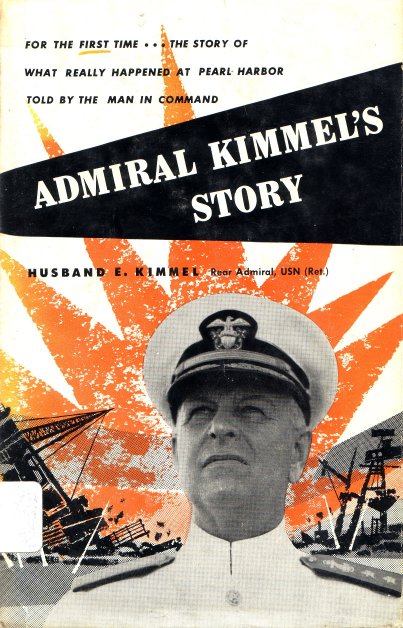
Admiral Husband E. Kimmel: Bungler or Fall Guy?

The Pearl Harbor attack on December 7, 1941, was one of the most unforgettable events in U.S. history. It catapulted the country into World War II.

Pearl Harbor aftermath

Aftermath of Pearl Harbor attack (photo courtesy Atomic Heritage Foundation)

The need to understand events and point the finger of blame led to nine investigations between 1944 and 1946. A central figure throughout was Admiral Husband Kimmel. Kimmel had been a rising star in the U.S. Navy since 1915. By 1941 he was commander of the U.S. Pacific Fleet.

But on that fateful December day, his stellar career collapsed. He was relieved of his Pacific Fleet command ten days after the attack.

Kimmel argued that intercepted Japanese cables suggesting an imminent attack were in Washington, DC, and not shared with him. In his eyes, he was a scapegoat for incompetence at higher levels. Kimmel’s critics pointed to tactical failures that had little to do with whether he knew the attack was coming.

Kimmel at hearings_1482456158364_7453076_ver1.0

Circa 1946: Adm. Husband E. Kimmel at Pearl Harbor Hearing. (Photo by George Skadding/The LIFE Picture Collection/Getty Images)   (Photo: George Skadding, Time & Life Pictures)

Historians still debate Kimmel’s role in the Pearl Harbor attack. Was he responsible for one of the worst disasters in American military history or did he simply get the unluckiest promotion of all time?

Husband Kimmel’s papers at the American Heritage Center contain his defense and materials for his book, Admiral Kimmel’s Story, published in 1955.

pearl2

Posted in American history, military history, Pearl Harbor Attack, Uncategorized, World War II | Tagged , , , , , , | 1 Comment

Mileva Maravic remembers Gebo, Wyoming

110 years ago, the coal-mining town of Gebo was established about twelve miles north of Thermopolis in Hot Springs County. The town took its name from Samuel W. Gebo, an entrepreneurial developer of the coal mines in Washakie and Hot Springs counties. New York investor Rufus Ireland and others were the financial backers who leased the land from the U.S. Bureau of Land Management. Gebo was the company town of their Owl Creek Coal Company. By 1929, there were about 1,200 employees and family members, with more than 600 employed in the coal mines.

Mileva Maravic (1912-2003) spent her childhood in Gebo. Her papers at the AHC contain historical materials she collected about the town. Also included are reminiscences by Maravic and other Gebo residents.

The excerpts below are from Maravic’s remembrances about the town.

“Everything was owned by the company—the houses, the store, butcher shop, utilities.  Rent was free.  The company charged $1.00 for a load of coal brought in a truck and emptied it in the coal shed by the houses.  A few chose to build their own house or added some rooms to their company house.”

Gebo HS graduation 1930 Mileva back row on right

Mileva Maravic as a high school graduate in Gebo, 1930. Mileva Maravic papers, American Heritage Center

“Gebo was a melting pot of nationalities and cultures.  There were Finns, Czechs, Slavs comprising two groups (the Serbians and Montenegrins).  Other nationalities Hungarians, Bulgarians, Russians, Italians, Scots, Irish, English, and two Japanese families.” (from “Gebo, Wyoming,” by Mileva Maravic)

“The [school] playground had swings, a slide and the monkey bars and a Merry-go-round.

School Playground Gebo about 1921

School playground, ca. 1921 (photo does not include Mileva), Mileva Maravic papers, American Heritage Center

Away from the playground and the school were two small buildings near a pile of large rocks.  They were the outdoor toilets.  One marked BOYS and the other GIRLS.”

“The Owl Creek Coal Company furnished the books.  The children bought paper, pencils, penholder made of wood into which you inserted a metal penpoint.  We also had to buy a bottle of ink which cost ten cents.  The desks had a round hole in the upper right hand corner for the bottle of ink.  The penholder with penpoint dipped in the ink we used when having Penmanship Class.  We practiced many days the push-pull exercises and making large round circles before the teacher accepted the papers which she sent to the Palmer Method Company in Chicago.  They graded the papers and if satisfactory were returned to the School with a Certificate having our name on it.  We also received a Palmer Method Pin we could wear.” (from “The Gebo School,” by Mileva Maravic)

Gebo High School 1930 Mileva front row 3rd from left

Gebo High School, 1930 (note that photo is all girls). Mileva is front row third from left. Mileva Maravic papers, American Heritage Center

“Children entered the Pool Hall at the back door, waited until the clerk came to ask what kind of candy bar, soda pop we wanted.  We could buy with pool hall chips miners sometimes gave us.  A small building near the front of the Pool Hall was the Barbershop.  No women went in the Barbershop.  In the back of the Pool Hall was a round open structure where the Gebo Miner’s Band gave concerts in the summer.” (from “Gebo, Wyoming,” by Mileva Maravic)

Gebo Miners Band undated

Gebo Miner’s Band, undated, Mileva Maravic papers, American Heritage Center

“Growing up in Gebo, Wyoming in the 1920’s was a pioneer life compared to to-day’s living.  It was a simpler life.  It seems though, no matter how rough things were — the place we were young is always close to one’s heart.  Some part of me will always be where I grew up…….Gebo, Wyoming.” (from “Remembrances of Gebo, Wyoming,” by Mileva Maravic)

Gebo HS graduation 1930 Mileva back row on right

High school graduation, Gebo. 1930. Mileva is back row last on right. Mileva Maravic papers, American Heritage Center

By 1938, the coal mines had closed. Mail service to the town was discontinued in December 1955. By 1971 the town was bulldozed, although some buildings and the cemetery remain.

The American Heritage Center is a place to get information not found in many books or even online sources. We have firsthand data and evidence from letters, reports, notes, memos, photographs, audio and video recordings, and other primary sources. We’re accessible onsite at the University of Wyoming and online. No appointment needed to get your information!

Posted in Coal industry, Economic Geology, found in the archive, Local history, mining history, newly processed collections, Western history, women's history, Wyoming history | Tagged , , , , , , | 41 Comments

Terror in the Theater – Fifties Fears

Science fiction films of the 1950s commonly expressed several themes: fear of technology leading to unintended consequences; invasion of the planet by aliens; and the effects of atomic radiation. Because science fiction movies were not constrained by reality, more imaginative outcomes and plot lines could be addressed in creative ways.

Forbidden Planet, one of the best science fiction films of the Fifties, illustrates that if the advanced race, the “Krel,” could not control their technology, what hope did humans have of controlling theirs.

Forbidden

In 20,000 Leagues under the Sea, Captain Nemo, hoping to abolish war among the world’s nations, realizes the world is not ready for his advanced technology, which he then destroys by what appears to be an atomic blast.

20000 leagues

The fear of the effects of radioactivity was a common science fiction movie theme during the Fifties. Strangely, the effects of exposure to radiation often did not include becoming radioactive, but might lead to the shrinking or enlarging of humans or the creation of monsters dangerous to human life.

The main character in The Incredible Shrinking Man is exposed to a radioactive cloud, which causes him to shrink.  The movie can be interpreted as an example of the paranoia of the Cold War era, as familiar surroundings, such as his wife, the neighbors, and the pet cat, become threatening to his existence.

Shrinking man

Lesser imitations of The Incredible Shrinking Man followed, such as The Amazing Colossal Man, which, instead of shrinking after being exposed to radiation, the main character grows to an immense size.  Unable to cope with his new reality, he goes on a destructive rampage which leads to his own destruction.

Colossal man

Godzilla, one of the more popular movie monsters, is awakened by an atomic explosion and then attacks Japan.

Godzilla

One of the most well-known science fiction films of the Fifties is Invasion of the Body Snatchers.  A story about an alien invasion, the movie is often seen as a commentary about the threat of Communism.  The pod people, which replace the humans of the movie, are emotionless with little ambition or desire, attributes Americans associated with Communists during the Cold War.  The film ends with the main character shouting: “Look you fools.  You’re in danger.  Can’t you see?  They’re after you.  They’re after all of us.  Our wives, our children, everyone.  They’re here already.  You’re next!”

Body Snatchers

The posters seen in this post are from the papers of Forrest Ackerman (1916-2008), a collector, editor, and writer of science fiction, fantasy, and horror. His collection at the AHC is full of memorabilia from many movies in this genre from the silent era through the late 1980s.

ah02358_0001

Forrest Ackerman, ca. 1955

Also called “Forry,” and “The Ackermonster,” Ackerman was central to the formation, organization, and spread of science fiction fandom, and a key figure in the wider cultural perception of science fiction as a literary, art and film genre. He’s also famous coining the nickname “sci-fi”. Now you can quiz your friends and family about who coined that famous phrase!

Posted in Cold War, Fantasy, Horror, motion picture history, Politics, Pop Culture, popular culture, science fiction, Uncategorized | Tagged , , , , , , , , | 2 Comments

Nellie Tayloe Ross: The (First) Governor Lady

On Nov 4, 1924, Nellie Tayloe Ross was elected governor of Wyoming, and became the first woman governor in the United States. Ross was elected a month after her husband, Governor William B. Ross, died suddenly of appendicitis.

On the day of her husband’s burial, the chairman of the state Democratic Committee asked a delicate question: Would Mrs. Ross consider running for governor herself? The election was a month away. Her supporters thought it was fitting that the first state to allow equal voting rights (Wyoming passed women’s suffrage in 1869) would also be the first to have a woman governor.

Over the next few days, as she and her brother George Tayloe went around and around on the question of whether she should run, he came to know his sister better. She was shocked and sorrowful over her husband’s sudden death, but she was also ambitious. “No one ever wanted it more,” George wrote to his wife. If she did run, she understood that ambition was a quality she would have to disguise. It just wasn’t seemly for a woman to look ambitious.

Nellie Tayloe Ross was a southern woman and, as an archetypal southern woman, she was gracious, funny and strongly loyal to her family and friends. She was also very intelligent. She came from Missouri, the border South, a complicated place for people like her who were born not long after the Civil War. Nellie came out of that place and time a complicated woman.

Nellie Tayloe Ross in Cheyenne home.jpg

Nellie Tayloe Ross in her home in Cheyenne, ca. 1910. Nellie Tayloe Ross Papers, American Heritage Center

Her opponent in the election, Republican candidate Eugene J. Sullivan, a Casper lawyer, campaigned hard. Nellie, still deep in grief, did not. Her campaign was conducted by her backers who spoke widely and took out ads on her behalf. Despite her backseat approach to campaigning, she won the election. Ross was inaugurated on Jan. 5, 1925 as the first woman governor by only a few days—Miriam “Ma” Ferguson, who had also been a state First Lady, was sworn in as governor of Texas just over two weeks after Ross took office.

Eleven days later after inauguration, now Governor Nellie Tayloe Ross appeared before the Legislature to review the progress of her late husband. The New York Times ran the headline, “Mrs. Ross Wears Hat Before Legislature,” and noted that she “defied precedent” by “wearing hat and gloves.” Other contemporary media accounts noted that she had “not lost her womanliness” and remained “ever feminine, never a feminist,” as noted in her Times obituary when she died in 1977. “Really, I dropped accidentally into politics,” she told the Times in 1926, saying she preferred taking a stroll along the boardwalk to discussing rumors of a 1928 bid for the Vice Presidency (which never materialized).

Ross as governor 1924-1926

Nellie Tayloe Ross during her tenure as Wyoming governor, 1924-1926. Nellie Tayloe Ross Papers, American Heritage Center

More than ninety years later, women politicians are still struggling with the balance of femaleness, ambition and power. As much as we may want to think we’re past caring how female politicians look, the 2016 election in which presidential candidate Donald Trump commented at the first debate that Hillary Clinton “…doesn’t have the look [to be president]” is an indication that looks are still a weapon to be wielded by the opposition. U.S. Senator Kirsten Gillibrand (D-NY) commented at the Real Simple/TIME Women & Success Panel in 2014, “When [a woman]’s appearance is commented on publicly during a campaign, it undermines her; it actually hurts her. And it doesn’t matter if the comment is positive or negative. It undermines her credibility.”

Ross also had to dispel the idea that she would use her power to rid the Wyoming government of men, and create an all-woman government (a 1925 man’s worst nightmare). Here’s what Time magazine reported in 1925 that she told the Associated Press when asked about her view of women in politics:

“It is most amusing and amazing to me, for example, to be asked, as I was soon after my election, whether I expected to appoint any men to office? This question, telegraphed to me from the East by a well-known metropolitan newspaper, had every indication of being quite sincere, and was apparently inspired by the fear that the elevation of women to executive office was likely to be followed by the dismissal of all men and the substitution of women in their places.”

Despite Nellie’s election as the first woman governor in the nation, at least one Wyoming woman of her time criticized Ross for not going far enough. In the papers of suffragette Dr. Grace Raymond Hebard of the University of Wyoming faculty there is a letter to national women’s suffrage leader Carrie Chapman Catt declaring that the “outstanding reason” Nellie was defeated “was due to the advisors that Governor Ross selected, all men.”

But woman’s rights in the political arena were not Nellie Ross’ main concern. According to a WyoHistory.org article about Ross by Tom Rea, “She cared about her family, but she also cared deeply about getting things done in the public sphere. She followed her ambition, saw her opportunities, took up the power available to her, and used it.”

Nellie Tayloe Ross’s papers, including correspondence, news clippings, and photographs are at the American Heritage Center. Much of the material has been scanned and is available for browsing as part of the AHC’s online digital collection.

Her story is also featured in the online exhibit “In Pursuit of Equality,” alongside other pioneering women who, as elected officeholders, helped challenge and redefine what equality means in Wyoming.

Credit is given to Tom Rea’s article “The Ambition of Nellie Tayloe Ross” on WyoHistory.org and Time magazine article (Nov. 4, 2014), “What We Can Learn From Nellie Tayloe Ross, America’s First Female Governor” for supplying text for this post.

Posted in Politics, Ross, Nellie Tayloe, western politics and leadership, Women in History, Women in Politics, women's history, Wyoming history | Tagged , , , , , , | Leave a comment

Jean Howard, Photographer for the Glamorous Hollywood Set

Jean Howard parlayed her extraordinary beauty, ethereal glamour and light-hearted intelligence to become a Ziegfeld girl, a Hollywood starlet, a legendary hostess and the “house photographer” of the film colony.

Her circle included Tyrone Power, Vivien Leigh, Laurence Olivier, Humphrey Bogart, Lauren Bacall, Gary Cooper, Marlene Dietrich, Greta Garbo, Judy Garland, Cole Porter and Marilyn Monroe. They mingled at Howard’s Spanish-style home on Coldwater Canyon Drive in Beverly Hills; she and her first husband, Charles K. Feldman, who used his success as the first super-agent to become a producer, bought it for $18,000 in 1942.

Everywhere, Howard snapped pictures. One shows Marlene Dietrich almost touching heads with Ann Warner, wife of Jack Warner, as they intensely discussed never-to-be known secrets over a smoky table at the Trocadero nightclub in Los Angeles.

Marlene Dietrich and Ann Boyer Warner

Marlene Dietrich and Ann Boyer Warner, 1940s. Jean Howard papers, American Heritage Center

Another is a scene from a 1950s garden party at the home of Clifton Webb. Humphrey Bogart is sitting in Webb’s lap chatting with an inscrutable Laurence Olivier.

Humphrey Bogart, Clifton Webb, Laurence Olivier at Webb's garden party, ca. 1950

Humphrey Bogart, Clifton Webb and Laurence Olivier at Webb’s home, 1950s. Jean Howard papers, American Heritage Center

Still another shows James Dean as he was about to begin filming for East of Eden. It was Dean’s first major screen role and the actor is seen here on the verge of stardom. This photo and others of Dean were shot in Howard’s backyard.

ah002361

James Dean, 1954. Jean Howard papers, American Heritage Center

Jean Howard was born Ernestine Hill in Longview, Texas, and grew up in Dallas. Her father took her to Hollywood one summer in the late 1920s, as a coverup while he was on a two-week spree with a girlfriend behind her stepmother’s back. She later returned to Hollywood and, in 1930, landed a contract with Metro Goldwyn Mayer as a chorus girl in Eddie Cantor’s Broadway hit, Whoopee. She also caught the eye of Louis B. Mayer who proposed marriage, promising to divorce his wife. In 1934, when she instead became engaged to Charles Feldman, Mayer threatened to torpedo Feldman’s career, although the threat never materialized. While Feldman and Howard later divorced in 1948, the two remained close friends and even continued to share a home.

Jean Howard with Cole Porter (right of Howard) and Howard Sturges in Athens, 1955

Jean Howard with Cole Porter (right of Jean Howard) and Howard Sturges, Athens, 1955. Jean Howard papers, American Heritage Center

Howard got serious about photography in the 1940s by studying the art and then began to receive assignments from magazines like Life and Vogue. Her photographic work coalesced into a picture book published in 1989 titled Jean Howard’s Hollywood: A Photo Memoir.

Many of her original photographs were stored in shoe boxes until being willed to the American Heritage Center upon Howard’s death in 2000. It is almost accidental that her photographs and other papers were received by the AHC. Originally AHC Director Gene Gressley wrote to Howard in 1980 asking for Charles Feldman’s papers. After finding that Feldman’s papers had already been donated to the American Film Institute, Gressley casually mentioned an interest in her materials, not realizing the treasure trove that would come to the AHC twenty years later.

Jean Howard’s collection consists of biographical materials regarding Howard and Feldman, correspondence, and subject files about her books, but mostly her celebrated photographs and their negatives. Howard’s personal photographs and negatives are also included.

You can also delve further into the captivating world of Jean Howard and her iconic Hollywood photography through an AHC virtual exhibit, “Jean Howard’s Hollywood: ‘The excitement, the glamour, and the good times.‘”

Posted in Biography and profiles, found in the archive, Hollywood history, Motion picture actors and actresses, motion picture history, Photography, popular culture, women's history | Tagged , , , , | Leave a comment

The Adeline M. Leitzbach Papers: Part II of a Two-Part Series

Adeline Leitzbach once mused: “[In] the old days in pictures… we used to go out on a lot with a couple of actors, a horse, a camera man and an author. We used to shoot scenes, and mould them into a story. And they used to pay us ‘authors’ about twenty five dollars for such a story.” (“Why I Have Decided to Write for the Radio,” p. 1).

As her more than twenty credits attest, Leitzbach moved up the ladder and spent the 1910s through the early 1930s as a busy movie scenario writer. As most of her movies were produced during the silent days, many of them are lost. In fact, of the 20 known feature films and shorts for which Leitzbach is credited (alternately credited as Adeline Hendricks), few at all are known to survive and just two are available on DVD. A complete list with release year, director and leading players, Leitzbach’s specific credit, production company, as well as survival status, if known, follows. Note: The notorious 1937 Fox vault fire in Little Ferry, New Jersey resulted in the loss of most of the silent films produced by Fox Film Corporation, which would make it highly unlikely that Leitzbach’s four 1918 Fox films remain.

FEATURE FILMS CREDITED TO ADELINE LEITZBACH/ADELINE HENDRICKS (* = extant, or partially extant)

Diamonds and Pearls aka The Hour Glass (1917), directed by George Archainbaud; starring Kitty Gordon, Milton Sills, Curtis Cooksey; written by Adeline Leitzbach (credited as Adelaine Leitzbach). World Film. Survival status: unknown.

Stolen Honor (1918), directed by Richard Stanton; starring Virginia Pearson, Clay Clement, Ethel Hallor; scenario by Adeline Leitzbach from a story by George Scarborough. Fox Film Corporation. Survival status: unknown.

The Heart of Romance (1918), directed by Harry Millarde; starring June Caprice, Bernard Thornton, George Bunny; scenario by Adeline Leitzbach, from the screen story “Her Father’s Money” by Frances Crowley. Fox Film Corporation. Survival status: unknown

Her Price (1918), directed by Edmund Lawrence; starring Virginia Pearson, Edward J. Rosen, Victor Sutherland; scenario by Adeline Leitzbach from a story by George Scarborough. Fox Film Corporation. Survival status: unknown.

The Liar (1918), directed by Edmund Lawrence; scenario by Adeline Leitzbach from a story by Katharine Kavanaugh; starring Virginia Pearson, Alexander F. Frank, Edward Roseman. Fox Film Corporation. Survival status: unknown.

Dad’s Girl (1920), directed by David G. Fisher; starring Jackie Saunders, Jack Drumier, Kempton Greene; scenerio by Adeline Leitzbach (as Adeline Hendricks). Waldorf Photoplays, Inc. Survival status: unknown.

Ashamed of Parents (1921), directed by Horace G. Plympton; starring Charles Eldridge, Jack Lionel Bohn, Edith Stockton; scenerio by Adeline Leitzbach (as Adeline Hendricks) based on the story “What Children Will Do,” by Charles K. Harris. Warner Brothers Pictures. Survival status: unknown.

Wife in Name Only (1923), directed by George W. Terwilliger; starring Mary Thurman, Arthur Housman, and Edmund Lowe; adaptation by Adeline Leitzbach (as Adeline Hendricks) of her own play based on the Bertha M. Clay novel of the same name. Pyramid Pictures. Survival status: unknown.

Success (1923), directed by Ralph Ince; starring Brandon Tynan, Naomi Childers, Mary Astor; screenplay by Adeline Leitzbach and Theodore A. Liebler, Jr. [based on their play] with titles by George V. Hobart.  Murray W. Garsson Productions (distributed by Metro Pictures Corporation and Gaumont [France]). Survival status: unknown.

Counterfeit Love (1923), directed by Ralph Ince and Roy Sheldon; story by Thomas F. Fallon and Adeline Leitzbach; starring Joe King, Marian Swayne, Norma Lee. Murray W. Garsson Productions (distributed by Playgoers Pictures). Survival status: unknown.

* I Am the Man (1924), directed by Ivan Abramson; starring Lionel Barrymore, Seena Owens, Gaston Glass; scenario by Adeline Leitzbach (as Adeline Hendricks). Chadwick Pictures. Survival status: A Welsh IMDb reviewer claims to have watched a French-language print used for exhibition in Belgian cinemas.

* Walls Tell Tales aka Great Actors and Authors #1: Walls Tell Tales (1928; short film), directed by Edmund Lawrence; scenario by Adeline Leitzbach and story by Irwin S. Cobb; starring Madge Kennedy, Roland Young, and Efrem Zimbalist. Famous Lasky Corporation. Survival status: a 16mm copy exists at UCLA Film & Television Archive (UCLA catalog, inventory number: M43411).

Manhattan Knights (1928), directed by Burton L. King; story and screenplay by Adeline Leitzbach; starring Barbara Bedford, Walter Miller, Betty Worth. Excellent Pictures. Survival status: unknown.

Two Masters aka Great Actors and Authors #2: Two Masters (1928; short film), directed by Edmund Lawrence; scenario by Adeline Leitzbach and story by Rita Weiman; starring Mary Eaton, Guy Bates Post, Minnie Dupree. Famous Lasky Corporation. Survival status: unknown.

Montmarte Rose (1929), directed by Frederick Hiatt and Bernard McEveety [director credits unconfirmed, per IMDb]; adaptation by Isadore Bernstein, written by Sylvia Bernstein and Jacques Jaccard, story by Adeline Leitzbach (as Adeline Hendricks). Excellent Pictures. Survival status: unknown.

* The House of Secrets (1929), directed by Edmund Lawrence; starring: Joseph Striker, Marcia Manning, Elmer Grandin; screenplay by Adeline Leitzbach, from the novel The House of Secrets by Sydney Horler. Chesterfield Motion Pictures Corporation. Survival status: The film is presumed lost (silentera.com), however a (partial?) sound disc of the film exists at the UCLA Film & Television Archive (UCLA catalog, inventory number M112644).

* The Dancing Town aka Great Actors and Authors #3: The Dancing Town (1928; short film), directed by Edmund Lawrence; scenario by Adeline Leitzbach adapted from the story “Daughters of Shiloh” by Rupert Hughes with titles by San Marx and Sidney Skolsky; starring Harry Beresford, Elizabeth Patterson, Charles Eaton, Helen Hayes. Famous Lasky Corporation. Survival status: a 16mm diacetate copy exists at UCLA Film & Television Archive (UCLA catalog, inventory number: M00884). This film was restored and shown at UCLA’s 12th Festival of Preservation on July 28, 2004.

* The Peacock Fan (1929), directed by Phil Rosen; starring Dorothy Dwan, Tom O’Brien, Lucien Prival; scenario by Arthur Hoerl, from a screen story by Adeline Leitzbach. Chesterfield Motion Pictures Corporation. Survival status: print exists [16mm reduction positive] (silentera.com) Available on DVD through Alpha Video; 85 minutes.

One Splendid Hour (1929), directed by Cliff Wheeler; written by Sylvia Bernstein and Jacques Jaccard, adapted by Isadore Bernstein, story by Adeline Leitzbach; starring Viola Dana, George Periolat, Allan Simpson. Excellent Pictures. Survival status: unknown.

* Notorious But Nice (1933), directed by Richard Thorpe; story by Adeline Leitzbach with screenplay and dialogue by Carol Webster. Chesterfield Motion Picture Corporation. Survival status: extant. Available on DVD through Alpha Video; 71 minutes.

Leitzbach’s most accessible film is the last known for which she is credited, Notorious But Nice. Produced by the Chesterfield Motion Picture Corporation, a “Poverty Row” studio that made low budget second-bill features, it has now fallen into the public domain. The movie featured a strong cast for its budget— Marian Marsh (who broke out as the female lead of 1931’s Svengali), Donald Dillaway (who had appeared in “A” pictures Min and Bill and Platinum Blonde), and Betty Compson (who had earned an Oscar nomination as Best Actress for 1928’s The Barker).

The film tells the story of small town girl Jennie Jones (Marian Marsh) whose secret past causes her to lose her man Richard Hamilton (Donald Dillway).  Betty Compson, plays Millie Sprague, a girl from the wrong side of the tracks that eventually comes to Jenny’s aid.

NotoriousCompson

From Notorious But Nice (1933), in which Jennie Jones (played by Marian Marsh) appears in court at the film’s climax.

UncreditedWorksPage

A page found within one of Leitzbach’s stories, suggesting that her work often went uncredited.

The scope of the Leitzbach papers suggests that she was a prolific writer and would indicate that she occasionally, if often, worked uncredited. A clue to the mystery can be found within the AHC’s collection. Typed inside the title page of the synopsis of a motion picture story called Captain Haide of the Royal Mounted Police is the following (as seen above): Screen Productions by the same author for the coming season: ONE SPLENDID HOUR [in caps], Gentlemen Preferred, Just Off Broadway, Chinatown Nights, Circumstantial Evidence. Leitzbach therefore may have been an uncredited writer on the  features: A Gentleman Preferred (a 1928 western directed by Arthur Hotaling and starring Gaston Glass, from Mayfair Productions), Just Off Broadway (a 1929 drama directed by Frank O’Connor, starring Donald Keith and Ann Christy, notably from Chesterfield Motion Picture Corporation and the credited screenwriter Arthur Hoerl of The Peacock Fan), Chinatown Nights (a 1929 crime-action movie directed by William A. Wellman, and starring Wallace Beery and Florence Vidor, from Paramount Famous Lasky Corporation), and Circumstantial Evidence (a 1929 drama directed by Wilfred Noy, starring Cornelius Keefe and Helen Foster, also notably from Chesterfield Motion Picture Corporation). This would explain the break from 1929 to 1933 in her credits.

Chinatown Nights

The extant Chinatown Nights (1929), does not feature a credit for Leitzbach, who may have worked on the film uncredited.

Also of interest among the AHC’s Leitzbach papers is the story Mother Knows, for which a handwritten note scrawled across the cover reads: “Sold to Chesterfield Pro — Sept – 1933 thru Jay Packard” [Packard was Leitzbach’s agent]. The story concerns the Briggs children: Edward (age 23), Grace (age 19), and Albert (nearly 18) who, sick of small town life, decide to head to the big city to find their fortune. Cross-referencing the story with the Chesterfield productions of the mid-30s, no such movie appears to have been made based on it. Therefore, in addition to her uncredited work, there is potential that she had story sales for movies that were unproduced.

The final chapter of Leitzbach’s writing career concerns her interest in writing for radio. Within The New York Public Library’s Adeline Leitzbach papers, Billy Rose Theatre Division, are letters that she wrote to New York radio station WOR. In a response to an inquiry sent to the NYPL, the collection “contains a few letters regarding WOR. They are about procedure of submission and one regarding an appointment. None address the success or failure of any submissions.” No known radio show by Leitzbach has been identified (notably, none exist at the Paley Center for Media, a major repository of radio programming).

Within the AHC’s Adeline Leitzbach Papers are three manuscripts of note regarding radio. They reveal her dedication to her craft and her love of New York City. To begin with, is Leitzbach’s 3-page essay entitled “Why I Have Decided to Write for Radio.”  In the undated document she writes: “…. the head of a large motion picture organization who had just offered me a job in the scenario department of his company… looked at me aghast when I said I didn’t want to go to Hollywood, that I intended to remain in New York and write for the Radio…. Radio Audiences to-day are demanding programmes of interest and merit. That of course, goes for the dramatic playlets that are presented on the air. We have fortunately a few very fine programmes, and as time goes on, radio will develop as pictures did, in the dramatic field of writing.”

WhiteCollars&OverallsPage

A page from Leitzbach’s radio script, “White Collars and Overalls,” offering some typical dialogue.

Additionally, there is a three-episode “pilot” for a radio drama entitled “White Collars and Overalls.” As noted in the opening announcement of the script, this was intended to be “the first of a series we call City Close-ups in which we take you into the homes, the highways and the byways of the great city of New York. We show you the little tragedies and the comedies in the lives of the dwellers in the greatest city of the world.” In fact, Leitzbach’s radio play offers a personal touch as it features the character Otto Krause, a German immigrant like herself, and centers around his family and their prosperous bakery and lunchroom.  Interestingly, for the final episode of the “pilot,” Leitzbach offered the following in the show’s announcement: “If any member of our radio audience would like to hear about any particular section of New York, if they will send in their request to this office, Miss Leitzbach, the author of City Close-up[s] will tell them a story of the locality in which they are interested.”

WomenintheNewsPage

The first page of the radio script, “Women in the News,” a curious manuscript in the Adeline Leitzbach papers.

Lastly, as relates to radio, is the curious appearance of the script of a produced show from NBC, broadcast on November 13, 1931. Called “Women in the News” the 3-page script offers the “gossip-fest” of Sylvia Gay, who talks directly to the ladies about tidbits in the news. The orchestral opening is the “Who Is Sylvia” Theme. Could Leitzbach herself have been Sylvia? Did she ghostwrite this radio series? One can only guess, as no other mention of the show exists in the files.

From the end of her career to its beginnings, also within the Leitzbach papers is a novel that the teenage Adeline wrote circa the turn of the century. Wrapped in a now shredded manila envelope, the 238-page single-spaced tome concerns sultans, knights, and princesses.  Alternately titled The Crown of Glory and Life’s Guiding Star, it is both preceded and followed by descriptive phrases: “A Romance of the Holy City” and “A Romance of ‘Ye Olden Times.’” On the first pages are some adolescent doodlings and on the back of the last page Adeline was practicing her signature, especially her curlicue “A,” no doubt with daydreams of her future fame as a celebrated novelist.

CrownofGlory1of2

CrownofGlory2of2

Pages 88 and 89 from Leitzbach’s The Crown of Glory

Leitzbach’s death date is not entirely confirmed, but sources indicate that she died in 1968 in New York City at the age of 81.

The Adeline M. Leitzbach papers at the American Heritage represent the largest collection of her work in one location.

— Gary Rutkowski, Archives Intern/Graduate Student in UW American Studies

Posted in Authors and literature, Hollywood history, Interns' projects, motion picture history, newly cataloged collections, popular culture, radio history, Uncategorized, women's history, writers and poets | Tagged , , , | Leave a comment

The Adeline M. Leitzbach Papers: Part I of a Two-Part Series

papers

Three manuscripts from the Adeline M. Leitzbach papers.

A working writer of early 20th century stage and screen, Adeline Leitzbach had a formula for successful writing, “Careful plot, careful character delineation, well established atmosphere and plenty of heart interest with a dash of comedy thrown in.”

In the silent film era, the female voice was particularly strong in comparison with today; half of all copyrighted films from 1911-25 were written by women. Among these writers was Adeline Leitzbach (1887-1968), a screenwriter and playwright out of New York City, whose words graced the silver screen, Broadway, and, according to some sources, even the vaudeville stage. She worked alone or in collaboration, most famously ghost writing for budding acting sensation Mae West in the early-to-mid-1920s. It’s due to her connection to Mae West that Lietzbach is best known today, but that association is just a small part of her writing legacy.

Typing away at 2552 University Avenue in the Bronx, Leitzbach saw her fortunes rise along with her neighborhood, which blossomed in the ‘20s when middle-class families from Manhattan flocked to its new modern housing and convenient subway access to the city. Leitzbach’s work was usually set in and around the City and consisted of mysteries, dramas, and comedies. Her stories often centered around the upper classes, but she did enjoy writing smaller slices of life. On one of her manuscripts entitled “Unwelcome Wife” she notes: “This story has no murder, no robbery, no hold-up, no rape— no crime of any kind. There are no gunmen, gangsters, bootleggers or shady ladies in it…. It’s just a simple story of people and their emotions…. There are plenty of big scenes and tense situations to say nothing of big acting moments…. There is also opportunity for a great deal of comedy and laughs aplenty…” Additionally, toward the end of her career, Leitzbach created a radio series that featured stories of average people in the environs of New York City.

gary

Fall 2017 intern Gary Rutkowski peruses the Adeline M. Leitzbach collection.

The Adeline M. Leitzbach papers at the American Heritage Center consists of two boxes containing over 50 manuscripts— novels, stage plays, motion picture stories, radio plays, novels, and other pieces. Born in Buffalo, New York, Leitzbach and her mother moved to the Bronx following the death of her father in 1909. For movies produced both in Hollywood as well as New York, Leitzbach began to earn her living in as early as 1917. She had a few of her plays produced on Broadway and in 1922 began a brief collaboration with Mae West. With West she wrote “The Hussy” (1922; unproduced) and the scandalous “Sex” (1926).  Not only did the subject matter of “Sex” create a stir (landing Mae West in jail for 8 days on moral charges following a raid of the theater), but playwright J.J. Byrne sued West on the basis that his play “Following the Fleet” had been lifted and its moral message subverted. In court, Adeline Leitzbach appeared as a witness for the prosecution, admitting that she and West had adapted the Byrne original, however the presiding Federal judge threw the complaint out completely, washing his hands of what he felt were substandard and salacious plays that didn’t deserve defending. Following the courtroom dramatics, the “Mae West” period was over for Leitzbach, but her career continued. The AHC’s Adeline Leitzbach papers do not appear to contain any material related to her work with Mae West; the scripts to both “The Hussy” and “Sex” reside at the Library of Congress.

To be found among the AHC’s collection are two of Leitzbach’s Broadway plays— “The Night Call” (1922) and “Dora Mobridge” (1930), the later appearing under the draft titles “The First Stone” and “Dollars and Sex” (on one of the drafts, in the character list, there is an epplisis and a star penciled in next to Dora Mobridge’s name as if to indicate the title for which the play would ultimately be named). Neither play was well received in its day. “The Night Call” was panned by Women’s Wear’s Kelcey Allen: “ bootleggers, rum runners, the use of radio and constant diming of lights failed to make … [the play] an exciting thriller or mystifying production… The author has adopted about every conceivable method in an attempt to build a mystery melodrama with the result that it becomes a piece of crude patchwork.” (4/27/22). “Dora Mobridge” was lambasted by the New York Herald Tribune (“rambles from dullness to hysteria and back again to boredom” [New York Herald Tribune review by Howard Barnes, 4/21/30]) and the New York Times (“the most pathetic venture of the season” [New York Times, 4/21/30]). Her most prominent work for Broadway was “Success” (1918).  Although “Success” (written with Theodore Leibler, Jr.) does not appear in the AHC collection, a seed of the same story can be found under the title: “Death Comes to Broadway: An Original Drama for the Screen” (an 81-page treatment). Considering it’s genesis as a screen story, it’s therefore kismet that the Broadway show would eventually find its way to the silver screen when “Success” was adapted into a 1923 feature film with a screenplay co-written by Leitzbach and Leibler, Jr. (with titles by George V. Hobart). (Leitzbach’s sometime collaborator was the son of impresario Theodore Leibler, Sr., who, with his producing partner George C. Tyler presented 240 plays, notably bringing Eleanora Duse to America in the later part of her celebrated career.)

Image005

Scene from the feature film Success (1923), based on the Broadway play by Adeline Leitzbach and Theodore Leibler, Jr.

Success tells the story of alcoholic Shakespearean actor Barry Carleton whose wife leaves him to raise their daughter alone and who, many years later, is reunited with his daughter when they end up playing Lear and Cordelia together in what becomes an instant hit. In Leitzbach’s undated but presumably earlier story “Death Comes to Broadway,” noted actor Barry Steele, in the same situation, helps his long lost daughter become a stage success but keeps his true identity a secret, until he winds up in the hospital in the climax, at which point all is revealed.

The original Broadway show ran for 64 performances according to the Internet Broadway Database, and received a rave review from The New York Times (“stiring heart appeal and an abundance of humorous lines… unusually well acted” [New York Times review by Eugene Kelcey Allen, 1/29/18]). The 1923 film featured ingénue Mary Astor, who would soon co-star in two high profile John Barrymore vehicles and would later win an Academy Award. There are no known film prints of Success. Two still photos from the production were recently added to the Leitzbach papers. Without captions, one appears to feature Stanley Ridges and Mary Astor, the other Naomi Childers and Brandon Tynan, left to right respectively below.

Stay tuned tomorrow for Part II of this series about Adeline Leitzbach and her papers at the AHC.

– Submitted by Gary Rutkowski, AHC intern from UW American Studies

Posted in Biography and profiles, Uncategorized, Women Writers | Tagged , , , , , | Leave a comment

Elizabeth Orpha Sampson Hoyt, Notable Woman of the West

Born December 7, 1828 in Athens, Ohio to an adventurous father and a pragmatic mother, Elizabeth Sampson early on displayed qualities of both parents.

A letter to Grace Raymond Hebard from Elizabeth’s son Kepler tells a delightful story from his mother’s youth. He writes that while a young girl, Elizabeth ran away from home and ended up near the property of an astrologer in the Cincinnati area. The astrologer and his wife befriended her and proceeded to chat with her about gardening, horoscopes and fortune telling. This incident, complete with psychic predictions for the future, stayed with Elizabeth her entire life. She preferred dealing on a personal level with the spiritual world rather than seek involvement or association with organized churches, mediums and such.

By the age of 10, Elizabeth had developed such a keen sense of curiosity and an, “…unusual interest in philosophy…” that she was allowed, “…special admission to the class in mental philosophy, taught by President William H. McGuffey of the Ohio University, Athens.”* She went on to study Greek and, by the age of 12, was a regular contributor of verse to the press in her early teens. While still in her youth, she went on to teach philosophy at the Female Seminary in Worthington, Ohio.

Because of her deep love of children, Elizabeth became an avid writer of children’s stories and poems.  One of nine children, she endured while most of her siblings died during early childhood. Elizabeth’s exceptional published works earned her more compensation than her peers and were often considered for illustration. Drawn from her own life, her insightful prose was broad to include historical, romantic, political, sociological, and philosophical subject matter. Many of Elizabeth’s published poems appear in Poets and Poetry of the West by William Coggeshall, published in 1864.

WomenofWyo._Vol1_61

Photo of Elizabeth Hoyt from Women of Wyoming compiled by Cora Beach and published in 1927. A copy of the book can be found in the American Heritage Center’s Toppan Rare Books Library

Teaching, in Elizabeth’s opinion, was second only to spiritual leadership. Nevertheless, she was a passionate advocate for many issues. Near to her heart were public libraries, all things of a patriotic nature, religious liberty, and the impoverished. She was particularly interested in “…birth control, in women’s higher education, in equal suffrage, and in the general advancement of her sex.”** Although, she considered herself a ‘natural realist’ in all things philosophical, according to Cora Beach, compiler of Women of Wyoming (1927), Elizabeth’s “…life was preeminently one of cheerful sacrifice” (p. 61).

Elizabeth arrived in Wyoming with her husband Dr. John W. Hoyt when he was appointed Wyoming’s Territorial Governor in 1878. He served as governor until 1882. Five years later, John Hoyt became UW’s first president, serving from 1887 to 1890. Elizabeth had married John at the age of 26, already having lived a selfless and dutiful life that was marked by perseverance. Elizabeth’s support and encouragement of her husband was renowned and she was regularly by his side at public events.

Her academic credentials included degrees in philosophy and psychology, which opened additional doors later in her life. From 1887 through 1891, she taught as Professor of Psychology and Moral Philosophy as seen in the UW circular of General Information from 1890-1891 as “Mrs. E. O. Sampson Hoyt, Ph.D., Lecturer”.

UWPresidents510000bx1fldr3CourseSchedEOSHoyt

Course Circular 1890-91, UW Presidents Collection, #510000, Box 1, UW American Heritage Center

After John Hoyt left the UW presidency in 1890, he and Elizabeth moved back east to the Washington D.C. area where she kept busy as an active member of the Society for Philosophical Inquiry.

Toward the end of her life, she often recalled lines from a favorite essay by naturalist, John Burroughs:

 I live my life with even pace,

I make no haste, I hail delays;

I stand amid the eternal ways,

And what is mine will know my face.

  – Submitted by Vicki Glantz, UW American Heritage Center Reference Dept.

*Women of Wyoming, p.59

**Women of Wyoming, page 62

Posted in Biography and profiles, Uncategorized, University of Wyoming, University of Wyoming history, Women in History, women's history, Wyoming history | Tagged , , , , | Leave a comment

Memorializing the United Air Lines DC-4 Crash on Medicine Bow Peak, October 6, 1955

Decades have passed since that fateful day when a United Air Lines DC-4 struck Medicine Bow Peak on the morning of October 6, 1955.

Flight 409, which originated in New York City with a final destination of San Francisco, was on its Denver to Salt Lake City leg when it struck the sheer granite wall west of Laramie in the Snowy Range during a snow storm.

Crash

The tail section of the United Air Lines DC-4 rests on a ledge high up on the granite wall. Most of the wreckage was removed the following summer in 1956, though some pieces still remain scattered across the boulder fields at the base of the cliff. Source: United Air Lines Flight 409 Crash Collection, American Heritage Center.

In the years since that tragic event, there have been numerous efforts to memorialize the tragedy that claimed the lives of 66 passengers and crew members. In 1997, the American Heritage Center hosted an exhibit and panel discussion. Among those on the panel who described the tragedy were rescuers who assisted in the recovery effort.

A year earlier, Mel Duncan, who was a resident of Cheyenne, self-published a booklet that details the crash. It was available in local book stores for many years. A copy of his manuscript resides in the United Flight 409 Crash records and is digitized where it can be viewed online along with many other materials from the collection. Duncan was instrumental in the placement of a memorial plaque placed at the foot of the mountain at the Miners Cabin Turnout on Highway 130. The monument was dedicated on August 25, 2001, where many family members of those who perished were present for the memorial service.

Duncan

Mel Duncan speaks to a large group of attendees, including family members of those who perished, during a memorial service held on August 25, 2001, at the Miners Cabin Turnout on Highway 130. Source: United Air Lines Flight 409 Crash Collection, American Heritage Center

Granite marker

This plaque was dedicated on August 25, 2001, at the Miners Cabin Turnout on Highway 130. The Miners Cabin Turnout provides a spectacular view of the Snowy Range including the crash site. Source: United Air Lines Flight 409 Crash Collection, American Heritage Center

In 2016, a grave marker was placed at the burial site at Laramie’s Greenhill Cemetery. The grave, which contains unidentified remains, was previously unmarked. The marker was paid for by a friend of the pilot’s family.

DSCN0019

A grave marker was placed at the Greenhill Cemetery in Laramie in 2016 that marks the grave containing unidentified remains. Source: John Waggener

Other tributes include newspaper articles that contain interviews with family members.

The United Air Lines Flight 409 Crash Collection is held at the American Heritage Center. The collection includes photographs of the crash site; materials describing the rescue effort by several mountaineering clubs, including detailed sketches of the pulley system used to lower remains off the ledge; newspaper clippings; maps; and other written and published accounts.  There are oral history interviews available in both audio and transcribed formats. A videotape is also included showing the National Guard’s shelling of the mountainside and the use of horses.

Other material includes information about the Douglas Company and the DC-4 as well as written accounts of the November 1, 1955, United Airlines crash south of Laramie, near Loveland, Colorado. Collection material covers dates from 1939 to 2001. Some items have been digitized and are accessible through the collection’s finding aid.

For a visual overview of the recovery operation mentioned throughout this post, explore our Virmuze exhibit “UA Flight 409: The Recovery Effort,” which documents the challenging mountaineering work undertaken in the aftermath of the crash.

– Submitted by John Waggener, Associate Archivist, UW American Heritage Center

Posted in aviation, aviation history, Commercial Aviation, Local history, Memorials, Tragedies, Uncategorized | Tagged , , , , , , , , | 1 Comment

Snow Chi Minh Trail: The History of I-80 between Laramie and Walcott Junction

John Waggener, Associate Archivist at the AHC, has just released a new book, Snow Chi Minh Trail: The History of Interstate 80 between Laramie and Walcott Junction, published by the Wyoming State Historical Society, a non-profit membership-driven educational organization.

The title comes from long-haul truckers who dubbed Interstate 80 (specifically the 77-mile stretch between Walcott Junction and Laramie) the “Snow Chi Minh Trail,” a negative reference to the similarly mountainous roadway used by North Vietnamese soldiers to reach South Vietnam during the Vietnam War.

John explains: “Those guys saw a lot of action and relived some of it as they drove across I-80. Not many stretches of highway across America have generated so much interest to fill the pages of a book, but Interstate 80 between Laramie and Rawlins is one of those exceptions.”

This stretch of road in south-central Wyoming is steeped in tragedy, controversy, myth and even conspiracy. On October 3, 1970, the newly constructed stretch of Interstate 80 was dedicated. Residents had warned highway officials of the adverse weather conditions around the area of Elk Mountain and advised them not to build a road there. Wyomingites who knew their history reminded highway officials that the Union Pacific Railroad looked at that same area 100 years earlier when it was planning and constructing the nation’s first transcontinental railroad and decided against the shorter, more direct route. It wasn’t but four days after the road was dedicated that a winter storm wreaked havoc on motorists traveling on the new road.  Wyomingites referred to the road as a “monument to human error.”

Figure B

In the early years along the Snow Chi Minh Trail, bulldozers were needed to clear drifts like this one at Milepost 274.9 east of Arlington, Wyoming. Source: Ronald Tabler Papers, American Heritage Center, University of Wyoming.

“I started working on this project in 2004. It is pretty emotional to finally see it published,” John said, adding, “My family made many trips down I-80. Our road trips were full of sightseeing, explanations, and interpretations of the natural, cultural, and historical wonders found along the way.” One of his more vivid memories comes from an introduction to the Snow Chi Minh Trail in 1972 when his parents took him to a Wyoming Cowboys football game on October 7th (he still has the ticket stub). “The road conditions that day were favorable, but I will always remember the near whiteout conditions my dad got us safely through on several other occasions.”

John is a 5th generation Wyomingite, born and raised in the Interstate 80 town of Green River. He attended the University of Wyoming where he earned his undergraduate degree in education and geography and his graduate degree in geography. Since 2001 he has been a faculty archivist at the American Heritage Center where he enjoys preserving historical Wyoming documents and making them available to researchers.

Figure A

John Waggener “testing” the rails of a snow fence along I-80, 2008

The book is making its way to local booksellers around Wyoming, or can be ordered directly from the Society by contacting Linda Fabian, Executive Secretary, Wyoming State Historical Society, 307-322-3014 or linda@wyshs.org,

Posted in Uncategorized | Leave a comment