June 14th marks the celebration of Flag Day in the United States. The date is significant in that the Second Continental Congress had, on that day in 1777, adopted the “Stars and Stripes” as the flag of a budding nation. The assembled body resolved “that the flag of the thirteen United States be thirteen stripes, alternate red and white; that the union be thirteen stars, white in a blue field, representing a new constellation.”
As the nation grew, there were more stars added to the flag, but the thirteen stripes remained. Interest in honoring the flag grew as well. By the latter half of the 19th century, schoolteachers in Wisconsin and New York had begun arranging patriotic days for their pupils. Celebrations became grander and more elaborate. In 1894, 300,000 children participated in a day to honor the flag in parks across Chicago. President Woodrow Wilson established an official Flag Day by proclamation in May 1916. Not long after that, the United States entered into World War I. Patriotic sentiments were running high.
Here in Wyoming, University of Wyoming professor Grace Raymond Hebard took patriotism and respect for the flag seriously.
Dr. Grace Raymond Hebard with a small American flag. Photo File: Hebard, Grace Raymond, American Heritage Center, University of Wyoming.
Dr. Hebard taught free ten-week long citizenship courses to prepare immigrants to become naturalized citizens. It was a progressive, and perhaps somewhat controversial, act which fell under the umbrella of Americanization. Her courses were held in her University of Wyoming classroom, against a backdrop of the American flag. All of her lessons included some aspect of the patriotism that was expected of the future American citizens. Immigrants who completed Hebard’s evening classes were recommended for citizenship without having to complete any additional exams. After the naturalization ceremony at the courthouse, Dr. Hebard pinned a small silk American flag to the coat of each new citizen.
Hebard and students from her naturalization class, March 8, 1917. Box 21, Grace Raymond Hebard papers, American Heritage Center, University of Wyoming.
Following one such ceremony at Laramie’s courthouse, a lawyer present at the event said to Hebard, “Although you have no sons to send to war, you certainly have made three patriotic loyal citizens out of that number of aliens.”
Students of Dr. Hebard learned “The American’s Creed,” which was based on a statement written by William Tyler Page in 1917. Page had served as the President General of the United States Flag Association and was also the 28th Clerk of the United States House of Representatives. Referring to the Creed, Page said “It is the summary of the fundamental principles of the American political faith as set forth in its greatest documents, its worthiest traditions, and its greatest leaders.”
This copy of “The American’s Creed” was taken from a draft of a civics textbook written by Hebard, 1926. Box 48, Grace Raymond Hebard papers, American Heritage Center, University of Wyoming.
Dr. Hebard’s patriotic endeavors extended beyond the classroom. She served as the State Historian of the Daughters of the American Revolution. In that role, she assisted in the erection of monuments and markers across the state of Wyoming commemorating the route of the Oregon Trail.
Hebard beside a monument marking the Oregon Trail, east of Fort Laramie, 1914. Photo File: Hebard, Grace Raymond, American Heritage Center, University of Wyoming.
Whether it was in the classroom or in the community, Dr. Grace Raymond Hebard never shied away from waving the flag. You can pour through the papers of this patriotic University of Wyoming professor at the American Heritage Center.
Post contributed by AHC Writer Kathryn Billington.
The chute flies open and out comes a bucking bronc, with a rugged cowboy astraddle, trying their best to stay mounted – this iconic image is associated with rodeos across the West. And since 1975, a similar scene has played out in gay rodeo. Conceived as a fundraiser for a Reno senior citizens’ Thanksgiving dinner, the Gay Rodeo originated in Nevada.
Facing discrimination, the rodeo organizers were initially unable to find any farmers or ranchers to lease them the necessary livestock. But they persevered. Interest in the rodeo spread across the U.S., first to California and then to Colorado and Texas. For LGBTQ farmers and ranchers, the rodeo offered a vital social outlet and an opportunity to meet other likeminded rodeo competitors.
In 1985 the International Gay Rodeo Association (IGRA) was formed to provide some standardization of rules across the various state rodeos that had sprung up. Wayne Jakino, the founding president of the IGRA described the rodeo community as one that lets “competitors feel good about themselves and open closet doors.”
Gay rodeo events include everything in a traditional rodeo, from calf roping and pole bending to bull riding. Events are equally open to all genders and the competitors are entirely amateur. There are also a few events unique to the IGRA, known as “camp” events. These include steer decorating and goat dressing. There is also the “wild drag race” during which one of the three team members must dress in drag.
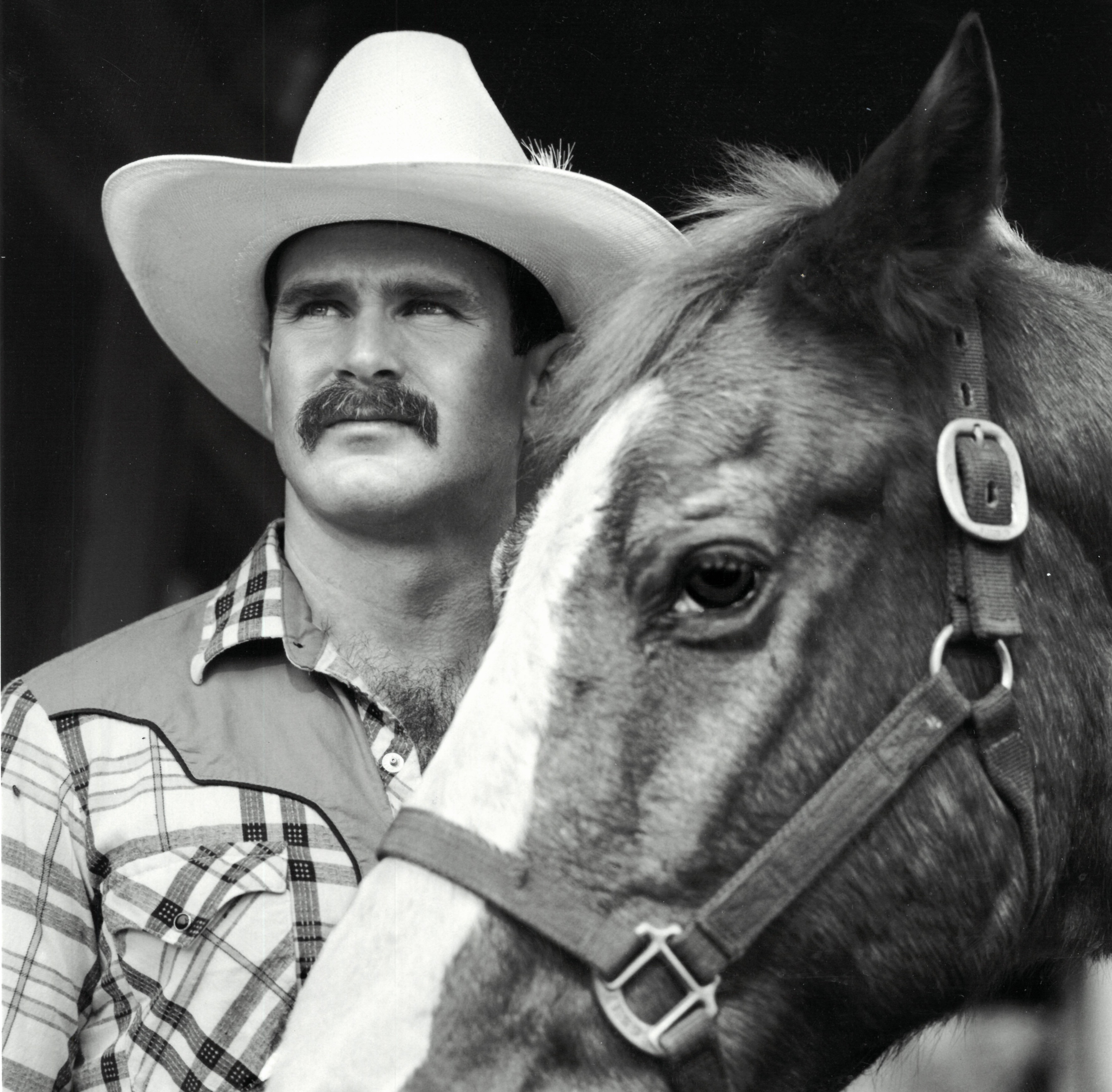
Shortly after the founding of the IGRA, Blake Little, an award-winning portrait photographer, began shooting photos of gay rodeo. Little’s black and white images captured candid scenes in and around rodeo arenas across the country.
Photograph of cowboy Jerry Hubbard taken in Burbank, California by Blake Little, 1989. Box 9, Gregory Hinton papers, American Heritage Center, University of Wyoming.
Blake Little became so enamored with gay rodeo that he learned to ride steers and bulls, eventually being named the Bull Riding Champion of the Year in 1990 by the IGRA. Little continued to take photographs between competitions, in part to steady his nerves and distract himself from overthinking his next bull ride. His photos raised awareness and opened doors. Little remarked, “The gay rodeo pictures are of a community that tends to be in a more conservative environment because Western culture just tends to be more conservative. It’s a powerful thing for people in Western culture that are straight or have more conservative views to see these people as real, as essentially just like them.”
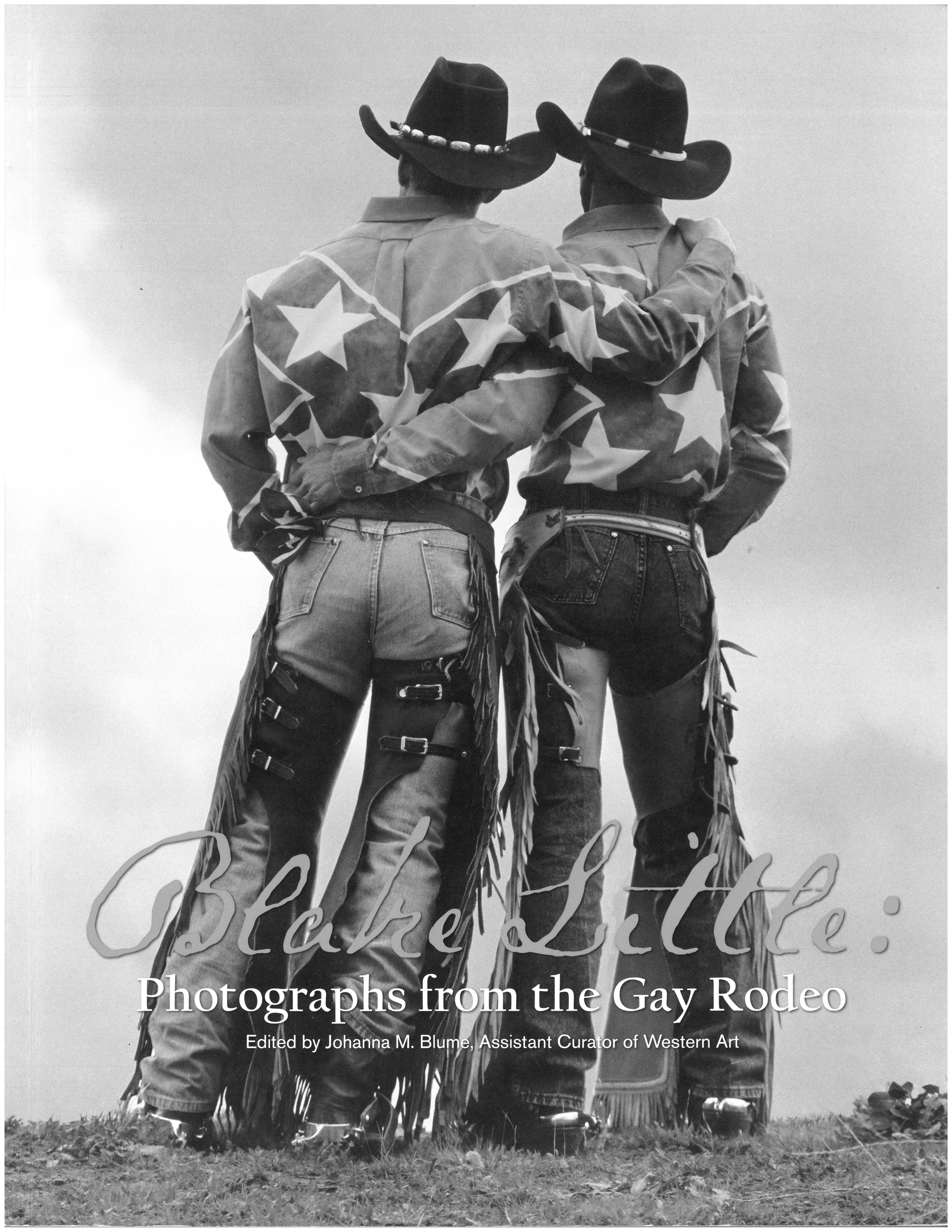
Eventually Little’s photos ended up on display in an “Out West” exhibition, which was conceived of in 2009 by author, playwright and filmmaker Gregory Hinton. The exhibition included art and memorabilia that highlighted the presence of the LGBTQ community in Western culture. Little’s photos were compiled into a book.
Cover of Blake Little: Photographs from the Gay Rodeo, 2016. Box 13, Gregory Hinton papers, American Heritage Center, University of Wyoming.
Today, IGRA events are held across the U.S. from Little Rock, Arkansas to San Diego, California and in Canada at the Canadian Rockies International Rodeo, near Calgary. The rodeo season ends with World Gay Rodeo Finals. Charitable giving continues to be a part of Gay Rodeo, with more recent rodeos donating to the Muscular Dystrophy Association and AIDS foundations.
Flyer for the World Gay Rodeo Finals, sponsored by the International Gay Rodeo Association, October 2013. Box 1, Gregory Hinton papers, American Heritage Center, University of Wyoming.
While the bulk of the International Gay Rodeo Association’s records are archived at the Autry National Center in Los Angeles, you can learn more about gay rodeo, the “Out West” exhibition and the contributions of the LGBTQ community to the American West in the Gregory Hinton papers.
For a closer look at LGBTQ+ media representation, explore our Virmuze exhibit “A Different Kind of Spotlight: How the Media has Portrayed Queerness Throughout the Decades.” Drawing from the AHC’s Bennett Hammer collection, this exhibit traces how mainstream media coverage of LGBTQ+ communities evolved from the 1980s and ’90s—from initial fear and controversy to growing acceptance and understanding. Just as gay rodeo helped “open closet doors” in Western culture, these archived newspaper clippings, editorials, and comics reveal the gradual shift in public discourse that made spaces like IGRA possible.
Post contributed by AHC Writer Kathryn Billington.
The American Heritage Center is home to nearly 90,000 cubic feet of historically significant collection material, representing centuries of cultural heritage within a wide range of subject matter. Whether it be a paper document, work of art, three-dimensional artifact, analog photograph, born digital media, or something else, collection material in any format presents unique challenges to archival preservation. Among the most troublesome of formats is nitrate film.
Cellulose nitrate-based films were produced from the late 19th century until 1952. Nitrate was the first flexible film base, developed to replace glass plate negatives, and was widely used for photographic film negatives, motion picture film reels, and medical X-rays. Though its invention marked a significant step in the evolution of photography, its risk quickly became apparent, as nitrate film is highly unstable and prone to combustion at as low as 104°F. Once ignited, nitrate film burns hot and fast, off-gassing oxygen and poisonous gases, fueling its own fire and making it extremely difficult to extinguish. Nitrate has even been known to explode or burn underwater. To address the risk of catastrophic fires in darkrooms, movie theaters, and hospitals as a direct result of nitrate film, cellulose acetate film was developed in the early 20th century and marketed as “Safety Film,” eventually replacing nitrate as a safer alternative.
Severely deteriorated nitrate film, photographed prior to deaccessioning in 2011. AHC photo.
Nitrate film can be kept safely in a cold storage vault, which protects the negatives from fire and significantly slows its deterioration. Over time, nitrate film will turn yellow and brittle, release harmful fumes of nitric acid, and the emulsion on the negative will decompose into a flammable powder, by which time the photographic content is lost forever. Acetate, or safety film, is not flammable like nitrate but does also deteriorate over time, so it is often kept in cold storage as well.
The first nitrate negative digitized with the AHC’s 100 MP camera: Lincoln County Wyo. Students at State Fish Hatchery. Undated, but circa 1919. Ah04459_0002, Box 4, Roland W. Brown Papers, Collection No. 4459, American Heritage Center, University of Wyoming.
One of the ongoing projects within the AHC’s Photographic Lab seeks to address these preservation issues. We start by pulling a box of negatives from the Cold Vault and appraise each negative individually, identifying its photographic content, condition, and level of deterioration. The next step of the project is to digitize each negative in order to preserve the historic content while allowing us to dispose of the original negatives as hazardous materials. Because our intention is to dispose of the originals, it is crucial that we digitize them to an extremely high quality. As recommended by federal archival guidelines, the AHC recently obtained a 100 MP digital camera which will allow us to digitize these film negatives in accordance with the highest current archival standard. This investment has significantly increased our ability to deal with the preservation issues previously outlined, with the additional benefit of making the photographs more accessible to our patrons.
To achieve preservation quality, the negative is carefully placed between a light table and a piece of specialized glass, then photographed in quadrants using an overhead camera stand. The images are stitched together and inverted in post-processing to create a positive master scan.
In the past two years, the AHC’s Photographic Lab has individually appraised 2,006 nitrate and acetate negatives across 12 collections. So far in 2021, we have digitized 393 of these negatives to preservation quality using the new camera. The subject matter of these negatives include University of Wyoming botany class field trips led by Dr. Aven Nelson in 1919, a Cheyenne Frontier Days rodeo held approximately a century ago, landscapes and portraits taken in the Himalayan Region in the 1920s-1930s, the aftermath of the Holliday fire which destroyed several blocks of downtown Laramie in 1948, and various other scenes illustrating life in Laramie and the surrounding communities in the 1910s-1950s.
An original nitrate film negative is visually compared with its preservation-quality positive scan.
The issues surrounding nitrate and acetate film are quite vexing, but the American Heritage Center is committed to preserving our share of photographic history for generations to come. The recent advancements of our digitization capabilities are exciting, and we are looking forward to sharing more of these photographs as the project progresses.
Curious about what happened during COVID-19 in Wyoming? For over a year, the American Heritage Center has been gathering the stories of people living through the pandemic all across the state. We are very excited to show some of what we have so far with our new COVID-19 in Wyoming website: https://sites.google.com/wyo.gov/covidinwy/home.
The COVID-19 in Wyoming website is a joint project that brings together the many wonderful COVID-19-related donations cared for by the AHC, the Wyoming State Archives, and the Wyoming State Museum. Since March 2020, all three organizations put the call out to Wyoming residents to share their thoughts, observations, memories, creative pursuits, and experiences. The AHC’s COVID-19 Collection Project encouraged people to get creative, and there has been a tremendous response.
On the online platform you’ll see Governor Gordon’s press conferences, video messages from theatre studios, photos from downtown Laramie and Cheyenne, students’ reflections, and much more. There are stories of struggle, coping, and worry about what the future will hold. One University of Wyoming student said how hard it is visiting her grandma – “I’m just used to…sitting right next to her and giving her a hug when I leave, and that’s something I can’t do and that just breaks my heart.”
But there are also stories of hope and optimism. Many businesses in downtown Laramie had cut-out hearts on their storefronts with inspiring messages, like “in this together” and “#notmeus.” One UW student said, “it’s been pretty amazing to see gas under $2.00.”
There are some of lighter moments, too. Richard Travsky took a photo of the famous T-Rex statue outside of the UW Geological Museum wearing a cloth mask.
T-Rex statue outside of the UW Geological Museum wearing a cloth mask. American Heritage Center COVID-19 Collection Project, Collection No. 560006, ahcdm_560006_002, American Heritage Center, University of Wyoming.
And there’s also a photo of the Ursus the bear sculpture wearing a mask at the Cheyenne Botanic Gardens.
Ursus the bear sculpture at the Cheyenne Botanic Gardens wearing a mask. American Heritage Center COVID-19 Collection Project, Collection No. 560006, ahcdm_560006_002, American Heritage Center, University of Wyoming.
These personal stories help shape our understanding of this dramatic and disruptive time. They provide glimpses and visuals into what people felt and what they observed, and give a depth to how we remember the past.
Today’s mountain climbers would call it free soloing, but in August 1923 it was simply three college students who were short on equipment. Brashly, they believed they could summit the Grand Teton.
David DeLap had taken up mountain climbing on a whim while a student at the University of Montana in Missoula. It was there that he met more experienced climbers Quin Blackburn and Andy DePirro. The trio set out in a Ford Model T with failing brakes they had purchased for seventy-five dollars. The goal: Climb to the top of the Grand Teton.
Photograph of Andy DePirro and Quin Blackburn as they begin their road trip to Yellowstone, August 18, 1923. Box 1, David F. DeLap papers, American Heritage Center, University of Wyoming.
Blackburn had procured an outdated topographical map from the geology department at the university but had no other knowledge of the mountain. They only allotted one day to make the climb, and when they arrived at the base of the mountain, they were equipped with small day packs containing chocolate bars, raisins and bacon sandwiches. DeLap’s climbing shoes were football cleats that had been retrofitted with three quarter inch steel spikes. Blackburn carried a geologist’s hammer which was to serve as an ice axe. None of the climbers carried a rope.
Photograph of the top section of the Grand Teton taken by W.O. Owen, showing the Grand Teton from a point about 1/2 a mile East of the base of the peak proper. In this view you are looking right across the glacier on the North East side of the peak. The view is taken just at above timberline at about 10,000 feet, July 1923. Box 1, David F. Delap papers, American Heritage Center, University of Wyoming.
Not long after heading up Bradley Canyon they got drenched by a rainstorm. Soaking wet, they traversed a glacier and then they came across an area of rockslide. They built stone cairns to mark the route of their climb. The group found ledges and crevices and eased themselves along, sometimes crawling across the mountainside.
Photograph Andy DePirro & David DeLap climbing above the glacier toward the saddle between Middle Teton and Grand Teton, August 25, 1923. Box 1, David F. DeLap papers, American Heritage Center, University of Wyoming.
Soon they came to a boulder eight feet above them. Below them was a canyon more than a thousand feet deep. A slip-up would be a disaster. By then, it had begun to snow, and a cold wind was blowing. Blackburn climbed up on the shoulders of DeLap and DePirro, then DeLap boosted DePirro up. Soon DeLap was standing alone on the ledge, with no obvious way up. Improvising, DePirro was persuaded to take off his trousers and lower them down to DeLap as a makeshift rope.
Eventually the group came to a chimney coated in ice. Blackburn, using his geologist’s hammer, chopped footholds going 50 feet up. The three men clambered over each other in a human chain, only to discover another chimney to ascend. They repeated their human chain climbing technique, known in mountaineering circles as a three-man courte-échelle.
At last, they had reached the top, at 13,747 feet. To their surprise there was a large cairn of rocks with a metal banner imprinted with words “The Rocky Mountain Club.” Embedded in the ice at the top of the cairn was a canister, left there in 1898, with the names of the original party which had ascended the Grand Teton. DeLap, DePirro and Blackburn marveled that they were the first party to summit the mountain in twenty-five years. They took photos at the summit using a Kodak Brownie camera.
Photograph of David DeLap and Andy DePirro at the summit of the Grand Teton, August 25, 1923. Box 1, David F. DeLap papers, American Heritage Center, University of Wyoming.
DeLap took a blank check from his pack, noted their three names, the date and time and added it to the canister in the rock cairn. By then it was 6:30pm and the group realized they would have to make their descent in darkness.
Climbing down two ice chimneys and from boulders to narrow ledges was even more hazardous than the ascent, but there was no other way down. Once again, they clambered over each other’s bodies. Thankful for glimpses of moonlight between the clouds and for the rock cairns they had built along the trail, the trio make their way back across the rockslide and the glacier until they reached the tree line. Exhausted, lacking sleeping bags or tents, they built a fire and huddled around it, eventually falling asleep.
DeLap, in reflecting on his experiences during the climb, remarked “there isn’t enough money in the world to take the risk of climbing back up there again.”
To celebrate May as Asian American and Pacific Islander Heritage Month, the AHC would like to feature the life and career of Chinese American actor Richard Loo.
Loo was born in Maui, Hawaii, in 1903. As a young man he moved to the mainland to continue his education, studying foreign trade at the University of California at Berkeley. Upon graduation, he pursued a career in an import-export business, but his company met hard times and failed during the Great Depression.
Loo turned his attentions to the stage, with his first acting job at a small theatre in San Francisco. His role was as a Chinese-speaking rickshaw driver, but he knew no Chinese. He overcame this obstacle by memorizing a Chinese menu, shouting out the names of Chinese dishes in his scene.
Loo’s first speaking role on film was as a farmer in The Good Earth. The movie was an adaptation of Pearl Buck’s Pulitzer Prize winning novel by the same name. The 1937 drama followed the lives of Chinese farmers struggling to survive.
Photograph of Richard Loo on the set of The Good Earth, 1937. Box 6, Richard Loo papers, American Heritage Center, University of Wyoming.
During and after World War II, Loo made a name for himself playing Japanese villains in film. His next major success came in the movie The Purple Heart, where he was cast as Japanese General Matsubi, a part for which he had to shave his head. It was a significant role for Loo and at the time, considered a breakthrough in casting an Asian for an Asian role. Often, white actors were made up in yellowface to appear Asian, taking on Asian character roles.
The Purple Heart was part of a series of wartime propaganda films that portrayed the Japanese in stereotypical fashion. It was loosely based on the capture, trial and execution of eight U.S. airmen by the Japanese during World War II. The movie was released in 1944 and was controversial for the degree to which the storyline followed the harsh interrogation and torture techniques employed by the Japanese. The U.S. government feared retaliation by the Japanese military over the content of the film.
Photograph of Richard Loo as Japanese General Matsubi and his American prisoners of war from the film The Purple Heart, taken from the Hollywood Citizen News, February 25, 1944. Box 6, Richard Loo papers, American Heritage Center, University of Wyoming.
Following the war, Loo had so many requests to play the role of a Japanese villain that he had to turn down parts. His daughter, Beverly Loo, recounted that her father “was known as the man who died to make a living. He was always stabbing himself or committing hara-kiri or kamikaze”. Despite his typecast roles, Loo took a patriotic pride in his performances in his many war-themed films.
From the 1940s through the 1970s, he appeared in more than 200 movies and added television performances to his repertoire. If an Asian character was called for, Loo was usually the one the producers phoned. In the 1968 comedy western TV series Here Come the Brides he was cast alongside a young Bruce Lee. Loo took the role of the aged patriarch, Chi Pei, of the Chinese Green Lantern Society.
A page from the script of the televised series Here Come the Brides, November 12, 1968. Richard Loo played the Chinese character Chi. Box 1, Richard Loo papers, American Heritage Center, University of Wyoming.
Loo’s last film was The Man with the Golden Gun, a 1974 James Bond movie. He played the role of a Thai capitalist, Hai-Fat, who bankrolled the villain, Francisco Scaramanga. Like many films, it was shot abroad. Loo’s work as an actor took him around the world, from Los Angeles, to London and Bangkok. Loo remarked “I have learned the value of travel… have learned to know and understand people living in other parts of the world. No other profession could provide the same wide experiences.”
Following his death in 1983, Loo’s papers were donated to the American Heritage Center. You can visit the AHC and pour through hundreds of film and television scripts where you can learn more about the many characters played by Richard Loo.
Post contributed by AHC Writer Kathryn Billington.
April 23rd, World Book Day, is an ideal opportunity to showcase one of the AHC Toppan Rare Books Library’s books. Lectures on Natural Philosophy by Margaret Bryan is but one sample of the many rare books the AHC has to offer. Published in 1806, it is an unusual treatise on a subject that few women at the time pursued – science. The book itself is handsome, with gold tooled binding and marbled edges. It features a frontispiece portrait of Bryan.
Portrait of Margaret Bryan from Lectures on Natural Philosophy. American Heritage Center, University of Wyoming.
The year of Bryan’s birth is unknown, but likely to have been before 1760. In addition to being a published author of scientific literature, she also ran a school for young ladies at Blackheath, a village south-east of London. Bryan began her publication with an open letter to her pupils, which included her own two daughters, entreating them to apply the lessons towards bettering themselves. She dedicated the book to “Her Royal Highness, The Princess Charlotte of Wales.” In 1806, the date of publication, Princess Charlotte was ten years old, granddaughter of the King and third in the line of succession to the throne in the United Kingdom.
Introductory page and dedication to The Princess Charlotte of Wales, from Lectures on Natural Philosophy. American Heritage Center, University of Wyoming.
The book itself is a compendium of thirteen lectures based on eight years of study and seven years of practical experience as a scientist, in an era in which it was remarkable for a woman to pursue scientific interests. The lectures had been previously distributed singly to subscribers – lords, ladies, dukes and bishops as well as university professors and booksellers. Lectures on Natural Philosophy was intended to instruct pupils and interested readers in the fundamentals of physics alongside a brief study of astronomy. The lectures are supplemented with questions and exercises designed to test her students’ knowledge of geography and astronomy.
Bryan’s first chapter addresses gravity and the contributions to science of Newton and Galileo. It moves on to the study of fire, the science behind the mercury thermometer and evaporation as a key to understanding the function of the steam engine. Bryan believed that science was intertwined with religion and that God had granted humans with the intellect needed to study and appreciate science. Her discussion of mechanics reads like a modern-day Physics book, with examples of pulleys, levers, screws and springs. She segues seamlessly into a study of man as a machine and the human physiology that makes breathing possible.
Bryan illustrated her lectures with experiments and diagrams, explaining the function of pneumatics and the mechanics of an air rifle, an unusual topic of study for young women. She summarized the physics behind both the hot air balloon and the diving bell.
Illustration of various experiments including the diving bell, from Lectures on Natural Philosophy. American Heritage Center, University of Wyoming.
At the time, the scientific study of electricity was in its infancy, so Bryan outlined the two competing theories of the day. One of the two theories was Benjamin Franklin’s. Bryan’s book outlines more than forty experiments that her pupils could perform to illustrate the merits of both theories of electricity. She did caution them, though, not to repeat Franklin’s famous kite, key and lightning experiment, as the electricity in the atmosphere was known to be so powerful “as to destroy animal existence.”
Bryan concluded her book with a fifteen-page glossary of terms, including the forward-thinking aeronaut, defined as “a person sailing through the air” and corpuscles, described as “small bodies or atoms.”
Learn more about the remarkable Margaret Bryan and scientific understanding at the beginning of the 19th century by viewing Lectures on Natural Philosophy in the American Heritage Center’s Toppan Rare Books Library.
Post contributed by AHC Writer Kathryn Billington.
You’ve probably heard of Juneteenth, but have you ever heard of Emancipation Day? Emancipation Day has been celebrated on different dates in the U.S. since the Emancipation Proclamation was signed by President Abraham Lincoln in 1862. The tradition of Watch Night is still sometimes celebrated in Black churches on December 31st to commemorate the night that abolitionists waited up for word of whether Lincoln had signed the proclamation. For many, continuing to celebrate Watch Night and Emancipation Day on January 1st was also a way to commemorate another new year of freedom each
As you have probably noticed, January 1st coincides with another big holiday, so other dates were also used over the year but the federal government now officially recognizes Emancipation Day on April 16th, the day Lincoln signed the Compensated Emancipation Act. Juneteenth is an iteration Emancipation Day, first celebrated in 1865 and now widely recognized in the U.S., which commemorates the day enslaved people in Texas were notified of their freedom two and a half years after it had been signed into law.
At Cheyenne’s Allen Chapel African Methodist Episcopal (AME) church in the 1960s, Emancipation Day was recognized in January. The Allen Chapel AME is the oldest Black church in Wyoming. It was founded in 1878 by Reverend Whitlock and continues to operate more than 140 years later.
One of three buildings that have housed the AME church in Cheyenne, ca. 1900. W.B.D. and Annette B. Gray Papers, American Heritage Center, University of Wyoming.
The American Heritage Center has a small collection of the Allen Chapel AME church’s records covering mainly the years 1967-1969. From these records, we can get a glimpse into what was important to the pastors and the congregation, including drives to raise funds for Christian educational and missionary work, annual conferences, Sunday school, and other special projects. For instance, Robert “Buck” Rhone included a letter to the congregation in the church service packet of 3 December 1968 appealing for funds for the church’s organ.
Robert “Buck” Rhone, father of Wyoming politician and teacher Liz Byrd, was active in the Allen Chapel AME Church in Cheyenne. Cheyenne African Methodist Episcopal Church Papers, American Heritage Center, University of Wyoming.
Robert “Buck” Rhone and his wife, Sudie, were active members of the congregation. Also active was their daughter Harriett Elizabeth Rhone, later known to Wyomingites as a dedicated teacher and the first Black woman to serve in the state Legislature, Liz Byrd.
Sudie and Robert “Buck” Rhone in 1975. Harriet Elizabeth Byrd Family Papers, American Heritage Center, University of Wyoming.
In January of 1969, congregation member Casper Leroy Jordan included a multi-part history of Emancipation titled “Our African Methodist Heritage” in the church service packet. Jordan gave special emphasis to the role of various church leaders played in convincing Lincoln to sign the Emancipation Proclamation, like that of AME bishop Daniel Alexander Payne. Meeting with Lincoln just days before he signed, the “ascetic prelate knew the evils of slavery, and sought, along with other communicats (sic) of his church to persuade the President to free the black man.” Like many other churches, the Allen Chapel AME took the opportunity in January remember the roles that both abolitionists and churches played in the emancipation of enslaved Black people in the United States.
This photo commemorates the 64th anniversary of the Allen Chapel AME Church in 1949. The church was founded in 1878, so this may commemorate the date they moved into their second building. Harriett Elizabeth Byrd Family Papers, American Heritage Center, University of Wyoming.
A rider and his horse thunder into view over the desert horizon, barreling towards the way-station where water and a fresh horse await. As the rider leaps off his horse and onto another, his mail bag swinging from his hand, he shoots the station manager a devilish grin. With a hollered “Thanks!” he’s off again, rapidly disappearing from view in the desert twilight.
The Pony Express has long been an icon of the American West. Although it only ran for 18 months, it played a crucial role in delivering important news, letters, and telegram messages across the country efficiently at a time when our country desperately needed it.
The Pony Express began operating on April 3, 1860, roughly a year before the American Civil War officially began. The route went from St. Joseph, Missouri to Sacramento, California and covered nearly 2,000 miles.
The Pony Express was first created as an attempt to connect the West Coast with the central government power in the Eastern part of the country. The idea was first thought up by Senator W. M. Gwin, who proposed it to William H. Russell. Russell was one of the partners of the Russell, Majors, and Waddell freighting firm, currently operating in the Western territories.
When Gwin first suggested the ideas to Russell, he intimated that “the seeds of possible division within California, as between the North and the South, might be rendered impotent by fast mail communication east and west.”[1] During this time, there was a movement to remove California from the Union. If the Pony Express had not been created by and maintained at a great personal loss to Russell, Majors, and Waddell, the only communication between the East and West coasts would have been the sea. The Pony Express was created to prevent massive miscommunication due to distance during a tumultuous time in America’s history.
Replica Pony Express saddle and mochila (mail bag) on exhibit at the Pony Express Stables Museum in St. Joseph, Missouri. Box 23, Robert West Howard papers, Collection No. 1138, American Heritage Center, University of Wyoming.
Stations were placed along the entire route where fresh horses or riders were swapped out. When the Express first began, stations were 25 miles apart. This turned out to be too far of a distance, however, and the system was altered to make each station roughly 10-15 miles apart. Every 10-15 miles, the horse was swapped out, and every 75-100 miles, the rider swapped.
“Leaving with the Mail.” Box 23, Robert West Howard papers, Collection No. 1138, American Heritage Center, University of Wyoming.
In total, there were about 190 stations along the Pony Express route. Each station was manned by two or three men and contained provisions needed for survival. One of the original Pony Express stations in Hanover, Kansas, actually still stands today and is preserved as a historical site. Of the stations, there were about 25 where riders would be swapped out. These were much larger to accommodate the riders who slept there. Riders were able to keep up an average pace of about 10 miles per hour and delivered mail from Missouri to California in eight to ten days.
Newspaper clipping concerning the Pony Express station at Hanover, Kansas. Box 89, Agnes Wright Spring papers, Collection No. 115, American Heritage Center, University of Wyoming.
An ad was placed in the Leavenworth Daily Times on April 2, 1860 reading “The great western enterprise, the Pony Express to California, starts on Tuesday, or April the 3d. It will run through in ten days, and will carry letters and messages at four dollars each. The telegraph on the California side, is finished to Carson Valley. Virtually then, the Pony Express will put the Atlantic States within eight days of San Francisco. For a private enterprise, this is one of the most important yet undertaken in this country.”[2]
“Pony Bob.” Box 23, Robert West Howard papers, Collection No. 1138, American Heritage Center, University of Wyoming.
As previously mentioned, the Pony Express only lasted 18 months. During the time the Express was running, workers were busy stretching telegraph wires across the American West. By October 24, 1861, the telegraph wires connected the East Coast to the West Coast. On October 26, 1861, the Pony Express was terminated. However, the final letters in transit on the Pony Express route were not delivered until November.
Pony Express monument in Mud Springs, Nebraska. Box 23, Robert West Howard papers, Collection No. 1138, American Heritage Center, University of Wyoming.
Riders on the Pony Express were some of the toughest people in the West. They endured fast-paced, grueling horseback rides across the country in all sorts of weather, often riding through dangerous terrain for hours on end. Now, we’re able to send messages with a single tap of our finger. We’ve come a long way from paying someone to deliver a message by pony.
Post contributed by Archives Aide Sarah Kesterson, AHC Reference Department.
#alwaysarchiving
[1] The Kansas Historical Quarterly, Winter 1959, Box 89, Coll. 115, Agnes Wright Spring Papers, American Heritage Center, University of Wyoming.
[2] News of the Society Meeting Recap, March 1950, Box 89, Coll. 115, Agnes Wright Spring Papers, American Heritage Center, University of Wyoming.
Like many American industries, the sugar beet trade grew from perceived opportunity and weakening in other formerly profitable U.S. markets. A decline in mining and agriculture in the 1890s led some entrepreneurs to seek their fortunes elsewhere. The sugar beet industry appeared to hold some promise as it could provide income for farmers, laborers, industrial workers, and capitalists. In 1899 a beet sugar factory was established in Grand Junction, Colorado, with funding from Denver mining magnates. In 1901, the same men incorporated the Great Western Sugar Company, which became the dominant producer of Colorado, Wyoming, and Nebraska beet sugar for more than sixty years. Another company, Holly Sugar, was established in Holly, Colorado, in 1905 and became another mainstay in the Wyoming sugar beet industry.
Beets were heavy and perishable, making them expensive and risky to transport great distances. Therefore, to make the industry profitable, factories to process the beets were located close to the source. Factories of this type were opened near the Wyoming beet growing fields in Lovell (1916), Worland (1917), and Torrington (1923). Each new factory quickly became the hub of the agricultural community in which it was built.
Sugar beet processing facility in Torrington, Wyoming, 1931. Photo File: Wyoming-Torrington, American Heritage Center, University of Wyoming.
Russian German families (who had experience with sugar beet farming), single Japanese men (until immigration restrictions eliminated them in 1907), and Spanish-speaking laborers from Texas, southern Colorado and New Mexico were brought in to help with the labors of sugar beet farming. Over the course of the twentieth century, the list of preferred fieldworkers would also include Native Americans, Filipinos, and South Asians. Low land prices in the early days of the industry led to upward mobility for Russian Germans as they were able to purchase their own farmland, a mobility not seen by workers of color.
The Emergency Quota Act of 1921 lessened the number of Russian Germans workers when the legislation restricted immigration by Southern and Eastern Europeans. But the Act set no limits on immigration from Latin America, due in part by lobbying by the sugar beet industry. Mexican nationals, called “betabeleros” (beet workers), were increasingly recruited to fill the labor void and lower field labor expenses.
Migrant laborers were almost exclusively perceived as “outsiders,” people different from the typical hired hands in the family farm system due to the work they performed and ethnic or cultural differences. While hired hands typically lived and socialized with the family for which they labored, this was a rarity for sugar beet laborers.
Great Western Sugar Company dinner in Lovell, Wyoming, ca. 1920. Box 2, Hugo G. Janssen Photographs, Collection No. 11712, American Heritage Center, University of Wyoming.Great Western Sugar Company picnic in Lovell, Wyoming, 1923. Company events appeared to lack people of color. Box 2, Hugo G. Janssen Photographs, Collection No. 11712, American Heritage Center, University of Wyoming.Separate gathering in Lovell, Wyoming, 1923. Many of the persons shown were most likely employed in the sugar beet industry. Box 2, Hugo G. Janssen Photographs, Collection No. 11712, American Heritage Center, University of Wyoming.
Growing sugar beets in the early twentieth century was an incredibly labor-intensive process, especially in terms of the hand or “stoop” labor that could not be mechanized. In the spring and early summer, laborers would first use a short-handled hoe to block (cut out undesired beet plants to have plants properly spaced) and then used their fingers on the other hand to thin (remove all but one beet plant from the cluster left by the blocking). A summer-long task was regular hoeing to keep out the weeds. By October, the beets were ready to be harvested. After the ground was loosened with a machine lifter, laborers pulled the heavy beets out by hand. Leafy tops of the beets were also cut by hand with a curved beet knife. The beets were piled in rows and then loaded by hand into wagons and hauled to a beet dump for processing or loading onto railroad cars.
Sugar beet laborer in Torrington, August 13, 1941. Photo File: Wyoming-Torrington, American Heritage Center, University of Wyoming.
Very early in the industry, labor gangs consisting of single men were quite common. However, recruiting families quickly became a high priority for sugar company agents. Families were readymade labor gangs with a cook and children, who were well suited to certain portions of the necessary labor. Indeed, after a day of fieldwork, women still had household duties of cooking and cleaning, making for a “double day.” By age 8 or 9, children were encouraged to take on work in the beet fields and were regularly pulled out of school. According to a 1923 study, children under the age of sixteen made up 52% of the labor force and accounted for 47% of the acreage tended. Although laborers saw education as beneficial, language barriers and the need for family income got in the way of effective education. Students often had to repeat grades due to the length of time they were out of school. Nevertheless, public school education was an integrative force as it allowed some immigrants to move into occupations other than field work, a crucial step to becoming integrated members of a community.
Children of beet laborers in Torrington, April 1931. Photo File: Wyoming-Torrington, American Heritage Center, University of Wyoming.
Laborers employed on farms near a city often lived in ethnically segregated settlements in the city and traveled daily to the fields. If the farm was too far away, they would live near the fields in temporary housing that was often shoddily built or run down.
The onset of the Great Depression in 1929 made things worse as the economic downturn hurt sugar-beet production. The rate paid to growers dropped from about $7.00 per ton in 1930 to about $5.15 per ton in 1932; total acreage fell 10%. A resulting labor surplus meant that companies and producers had little incentive to provide migrant workers with benefits or amenities to ensure their return the next year. Housing for migrants was often without indoor privies and water had to be drawn from wells and nearby streams. Children and adults of all beet-worker families during the Depression suffered high rates of illnesses and often lived together on the edge of starvation. In Torrington, children tied soiled rags around their bare feet and walked as far as a mile to school in temperatures twenty degrees below zero. Photos from the American Heritage Center below show living conditions of sugar beet workers in Torrington during the Depression in 1931.
World War II led to labor shortages and in 1942 the U.S. and Mexico signed the Mexican Farm Labor Agreement, creating what is known as the “Bracero Program.” The program, which lasted until 1964, was the largest guest-worker program in U.S. history. Sugar beet field work was one of the many agricultural areas in which they were employed. The Mexican government actually prohibited its citizens from working in Wyoming after 1963. But a discussion of the Bracero program in Wyoming will have to be left to another post.
As I was talking to my Wyoming native husband about this blog, he told me of trips in the early 1980s that he took from Sheridan, where he was employed, to his hometown of Green River. As he drove through the Bighorn Basin, at times he would see groups of about 30 laborers hand working the beet fields. By the early 2000s, mechanization, chemical applications, and hardier cultivars such as Roundup Ready sugar beets led a lessened need for human hands in the fields. 95 years after its first processing campaign, the Torrington factory closed in 2018, although the Lovell and Worland facilities are still operating as cooperatives.
There is a lot more to say about the sugar beet industry in Wyoming and the American sugar industry in general. Information can be found in holdings at the American Heritage Center, including the papers of University of Wyoming History professor Larry Cardoso, Wyoming historian Grace Raymond Hebard, sugar economist Joshua Bernhardt, Denver businessman John E. Leet, and others.
Post contributed by AHC Simpson Archivist Leslie Waggener.